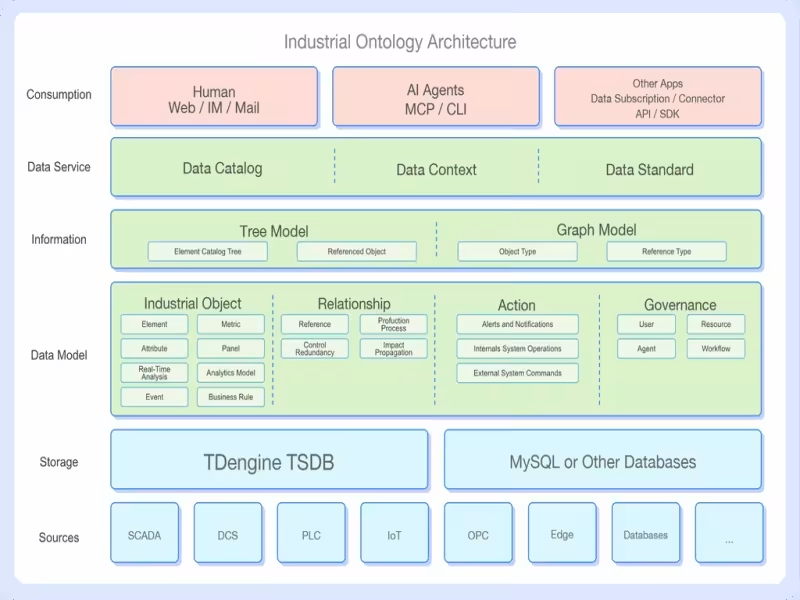
Global – October 27, 2026 -- Plants selecting an industrial data platform for AI should start with a single operational decision, such as whether a reliability engineer must review a compressed-air pressure drop within an hour, rather than with a list of AI features. That decision defines the required sources, history, context, access controls and response time.
Four data sources feed the compressed-air pilot
The example pilot investigates periods when header pressure falls while compressor energy use rises. It needs PLC compressor state and control values, historian pressure, flow and power trends, IoT vibration readings, and maintenance records. None of these sources has to be replaced; the test is whether the evidence can be found, understood, governed and accessed together at the necessary time scale.
Existing historians can stay in place
A platform does not need to replace the historian that holds trusted operational history. Evaluators should check whether data can be accessed without creating unmanaged copies, and whether timestamps, source identity, engineering units and the live-versus-historical distinction survive ingestion.
Context and governance decide whether data is usable
A pressure value gains meaning when tied to its compressor, header, line, unit and operating mode. Buyers should ask how asset identity, units, limits, quality flags, lineage and permissions are maintained and reviewed, and who owns that work. Without contextualization, each analytics effort may have to recreate the same tag mappings.
Workload and recovery need testing before purchase
Teams should define source counts, sampling rates, retention periods, concurrent users and historical query patterns, then validate response times against the pilot question. They should also clarify ownership of monitoring, backups and recovery tests, and how the platform behaves during network interruptions, service failures and restores.
Total cost of ownership extends beyond license price to source mapping, infrastructure, maintenance, support and historian compatibility. A smaller first use case can expose these costs early.
TDengine is one candidate to test
TDengine IDMP documentation describes ingestion from documented industrial and IT sources, an asset model, data contextualization, analytics, and connections to time-series or relational databases. Fit still requires checks on source protocol, deployment model, security boundary, data-access method, workload, recovery process and operational owner. The pilot should not be framed as proof of automatic root-cause analysis, fault prediction or energy savings.