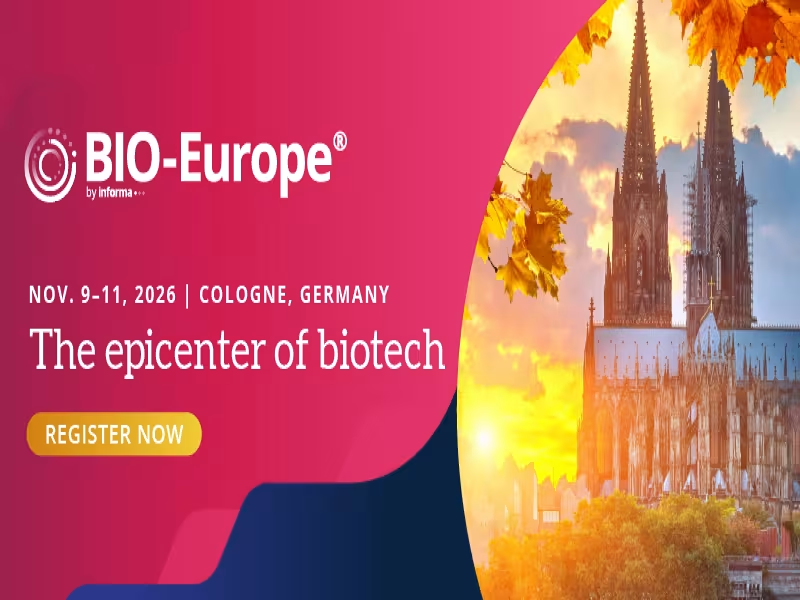
COLOGNE, GERMANY – November 1, 2026 – Informa Connect will host BIO-Europe 2026 in Cologne, Germany, on November 9–11, 2026, convening more than 6,000 senior executives from the global biotech, pharmaceutical, and investment sectors. The 32nd edition of the conference arrives as senior leaders report renewed confidence in biopharma dealmaking, even though financing challenges continue. Programming focuses on how scientific innovation is financed, developed, and brought to patients, alongside structured one-to-one partnering. For company teams, investors, and pharmaceutical partners, the event combines deal-making, strategic debate, and regional ecosystem access in one setting.
Survey Signals Rising Appetite for Partnering and M&A
Informa Connect cites findings from its inaugural Biopharma C-Suite Agenda Survey 2026, which polled 81 senior executives, including 50 CEOs. According to the survey, 75% of senior biopharma leaders expect appetite for partnering and M&A to increase over the next 12 months. These results will anchor the conference's Big Picture Plenary Series.
Claire Macht, Senior Portfolio Director, Europe, at Informa Connect, said the industry still faces fundamental questions about how scientific innovation is financed, developed, and brought to patients. She described BIO-Europe as a neutral platform where senior leaders can challenge established approaches, exchange perspectives, and address the strategic decisions shaping the future of biopharma. The framing positions the event as a decision forum as well as a meeting place for deals.
Plenary Debate Targets European Biotech Business Models and Funding
A central theme is whether established business models can support the next generation of breakthrough therapies as capital markets and regulatory environments change. Jeremy Levin, Prior CEO of Teva Pharmaceuticals, argues that CEOs should speak up when government action makes drug development harder, and that large venture funds must back young, science-based companies. Otherwise, he warns, Europe will keep exporting the science and buying back the medicines.
Edwin Moses, Chairman of NanoSyrinx, LabGenius, and Avantium, points to a critical pre-clinical funding gap in Europe as bigger venture capital funds concentrate on later-stage clinical development. He suggests those funds consider creating new, agile vehicles with specialist managers and risk appetite to sustain a future product pipeline. He also sees faster regulatory pathways as a major opportunity for Europe to lead.
Levin and Moses will continue the discussion in the Big Picture plenary "Building a Biotech in a Changing World – Europe's Choices." The session will examine whether traditional biotech business models can sustain breakthrough innovation amid shifting capital markets, platform-based company creation, and advances in AI.
European Life Sciences Coalition Session Focuses on Capital and Regulatory Pathways
A second Big Picture plenary will introduce the newly established European Life Sciences Coalition (ELSC). Participants will be invited to support an open letter to European leaders. The session is titled "Building a Competitive and Impactful European Biotech Community: Perspectives from the European Life Sciences Coalition and CEOs."
Melanie Senior will moderate, with representatives from Andera Partners, Angelini Ventures, Tubulis, and argenx. The panel will examine how institutional capital, regulatory pathways, and deeper public capital markets can support biotech company creation and growth in Europe. The lineup pairs investors with operating companies, so the discussion is likely to address both sides of the financing question.
North Rhine-Westphalia Offers a Host-Region Case for Ecosystem Building
Beyond financing and regulation, the program looks at how innovation ecosystems help biotech companies grow and compete internationally. The session "Building the Next Global Biotech Hubs: What Makes an Innovation Ecosystem Work?" will explore how talent, research infrastructure, investment, and industry collaboration combine to build successful life sciences clusters.
As host region, North Rhine-Westphalia is presented as an established life sciences ecosystem that brings together industry, research institutions, and healthcare organizations. Dr. Stefan Rensch of Bio.NRW said the region combines scientific excellence with a strong and diverse life sciences industry, and that hosting the event in Cologne puts its capabilities on an international stage. He added that local companies and research institutions gain direct access to potential investors, pharmaceutical partners, and international markets, which can help turn research strengths into commercial opportunities.
Partnering Tools and Registration Windows for Delegates
One-to-one partnering is now open through partneringONE®, giving registered delegates a structured way to arrange meetings ahead of the conference. A Digital Partnering Pass extends access beyond Cologne with virtual partnering days and on-demand content, including company presentations and panel discussions. Registration is open via the BIO-Europe website.
Key dates for attendees are:
November 6, 2026: last day of discounted registration rates
November 9–11, 2026: BIO-Europe 2026 in Cologne, Germany
November 17–18, 2026: virtual partnering days with the Digital Partnering Pass
Informa Connect, a division of Informa PLC, runs the event as part of its life sciences portfolio. The portfolio brings together senior executives, investors, and strategic partners across global markets. Delegates can find programme, partnering, and registration details on the official event page at bioeurope.