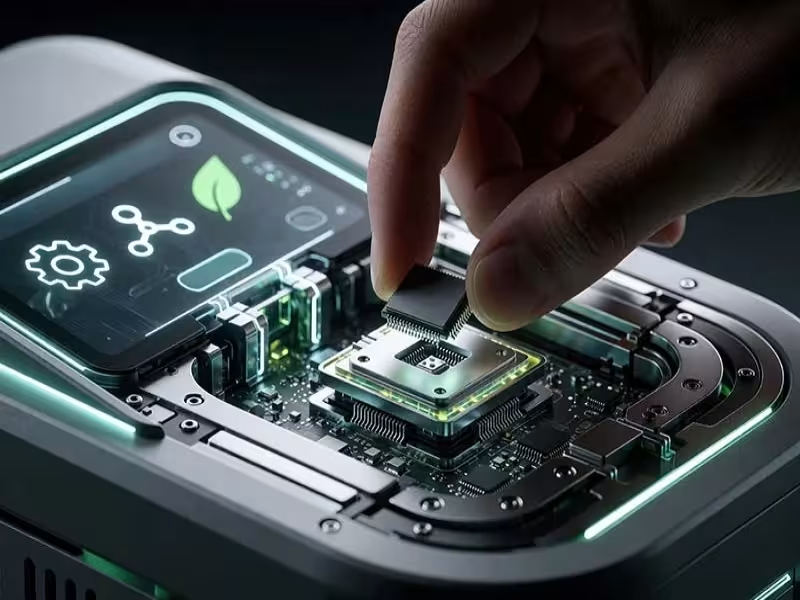
Global – – October 30, 2026 -- Rising memory costs and constrained memory supply are forcing cellular IoT device makers to decide whether their own engineers or the module supplier will requalify components when parts become unavailable, according to Telit Cinterion.
Hosted designs leave memory qualification with the manufacturer
In a hosted architecture, a host processor runs the application software while a separate cellular module provides connectivity. External memory and power management circuitry support the processor. The manufacturer keeps direct control over the application, and less software depends on a specific module, which simplifies switching suppliers.
If the selected memory becomes unavailable, engineers must qualify a replacement and verify its compatibility with the host processor. If it is not fully compatible, they may need to adapt the memory-communication software and revalidate the design.
Embedded processing can eliminate the host microcontroller and its external memory
Every cellular module contains a processor and memory for its firmware. Where capacity allows, the module can also run the device software. That can remove the host microcontroller and external memory, reducing component costs and board space.
A module with greater processing capacity may cost more, and its memory faces the same cost and availability pressures. If the memory becomes unavailable, the supplier must qualify and validate the replacement. Manufacturers should ask suppliers about long-term support and migration plans if the module or an internal component is discontinued.
Telit Cinterion's IoT AppZone spans LTE-M, LTE Cat 1, LTE Cat 4 and 5G RedCap
Telit Cinterion built IoT AppZone as a common software environment across its major LTE-M, LTE Cat 1, LTE Cat 4 and 5G RedCap products. Customers write applications in C and use common APIs, which reduces the product-specific code to rebuild when moving to another module. An abstraction layer shields developers from chipset-specific interfaces. Hardware and platform differences may still require adaptation.
The company also offers embedded environments for ThreadX and FreeRTOS real-time operating systems and for Linux. Apps on Linux supports applications that need user-space access, while Open Linux provides kernel-level access. Supported RedCap and 5G products use OpenWRT.
Telit Cinterion advises that architecture reviews weigh flash and RAM consumption alongside radio technology, rather than starting from the cellular standard alone.