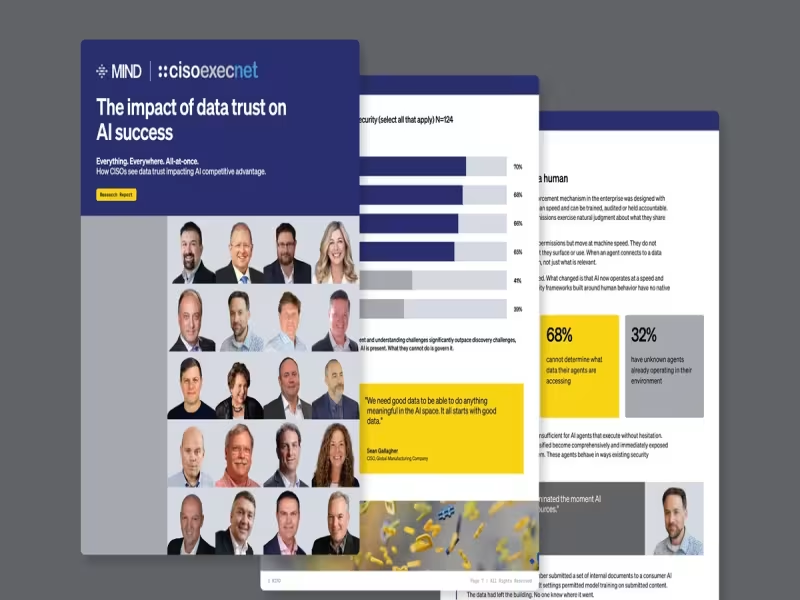
SEATTLE – October 23, 2026 -- Only 20% of enterprise AI initiatives meet their intended KPIs, and 65% of CISOs lack confidence in their data security controls, according to new research from data security vendor MIND and the CISO Executive Network.
The report, "The Impact of Data Trust on AI Initiative Success," finds that 90% of organizations already run enterprise GenAI at scale. Security governance has not kept pace with that deployment.
Survey of 124 CISOs finds policies without machine-speed enforcement
The study combines a survey of 124 CISOs with twenty in-depth interviews drawn from the same group. Organizations have AI policies but struggle to enforce them at machine speed, the report says. Data estates remain unclassified and ungoverned, and security frameworks were built for human behavior rather than autonomous systems.
Nearly two thirds of CISOs report low confidence in their ability to prevent unsafe AI data access. Business pressure to accelerate AI adoption continues to rise, which compounds that exposure.
MIND defines data trust as the gate to scaling AI
The report defines data trust as the degree of confidence that systems, including AI, use data safely and appropriately. High trust lets organizations move faster. Low trust causes AI projects to slow, stall or carry risk that outweighs their value, including regulatory exposure and potential business disruption.
MIND Co-Founder and CEO Eran Barak described the situation as "a structural gap between speed and control."
CISO Executive Network says data trust now separates safe movers from laggards
Bill Sieglein, Founder and COO of the CISO Executive Network, said member CISOs expect AI to deliver competitive advantage but worry about the risks. He called data trust one of the important deciding factors between organizations that advance safely and those that struggle.
The report treats AI as a stress test of existing security fundamentals. It frames data security as a business enabler and a competitive accelerant for companies with strong data foundations.
MIND ties the findings to its "Stress-Free DLP" model, which aims to let organizations understand, control and act on data risk in real time.