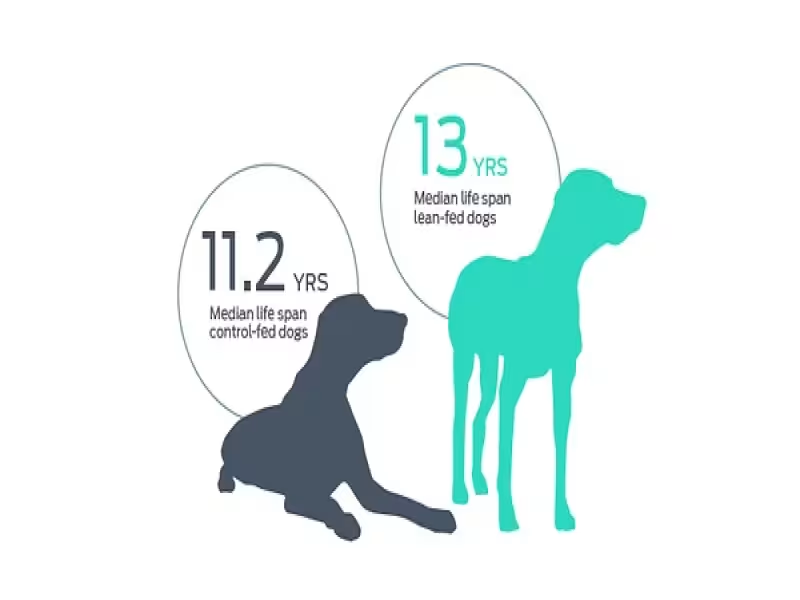
St. Louis – October 12, 2026 -- Labrador Retrievers kept lean from puppyhood lived a median of 1.8 years longer than heavier matched littermates, according to findings from the 14-year Purina Life Span Study, which the Purina Institute is revisiting on the study's 25th anniversary.
Lean-fed dogs reached a median life span of 13.0 years versus 11.2 years for controls
The study followed 48 Labrador Retrievers from seven litters. Each pair of matched littermates received the same complete and balanced diet, but one dog was fed 25% less food than its sibling to maintain lean body condition. The sibling served as the control. The Purina Institute describes it as the first-ever canine lifelong dietary study.
The 1.8-year gap equals a 15% extension in median life span. Lean-fed dogs also stayed free of treatment for age-related chronic conditions for longer, reaching 12.0 years before treatment was required versus 9.9 years for control-fed dogs.
Osteoarthritis affected 77% of control-fed dogs at age 8, versus 10% of lean-fed dogs
At 8 years of age, 10% of lean-fed dogs had osteoarthritis affecting two or three joints (hip, shoulder, elbow or stifle). Among control-fed dogs the figure was 77%.
Researchers built a biological clock for dogs from the study's longitudinal data
Researchers have used the data to develop and validate a biological clock and clinical markers that may help estimate biological age and predict health trajectories and mortality risk in dogs. The work was published in GeroScience in 2025.
Brittany Vester Boler, PhD, of Nestlé Purina PetCare Global Research & Development, said the study's data and samples are still helping the company pose and answer new questions about healthy aging in dogs.
Purina promotes its 9-point Body Condition System as a routine preventive-care tool for veterinary teams
Purina's 9-point Body Condition System helps veterinary teams and pet owners assess body condition, with an ideal score of 4 to 5 for dogs. The Institute recommends routine body condition scoring and nutrition counseling to make healthy weight part of preventive care.
Julie A. Churchill, DVM, PhD, DACVIM (SAIM and Nutrition), of the University of Minnesota College of Veterinary Medicine, said she integrates the findings into daily conversations with pet owners and in her teaching.