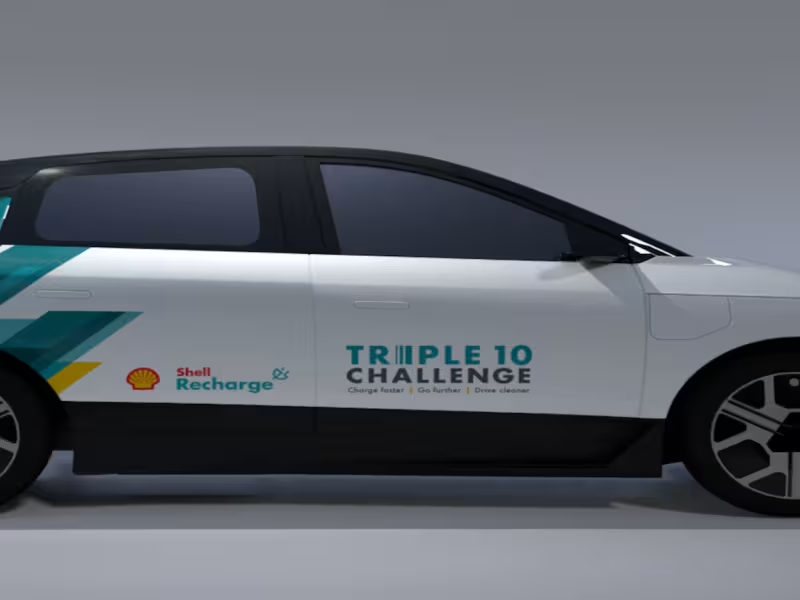
SHERIDAN, WYOMING -- June 24, 2026 -- Shell has unveiled the Triple 10 Challenge concept car, a road-worthy battery electric vehicle designed to demonstrate a new approach to EV thermal management using the company's advanced dielectric fluid technology. Revealed at HORIBA MIRA's proving ground in the United Kingdom, the vehicle targets three simultaneous performance benchmarks: a sub-10-minute charge time, 10 km/kWh driving economy, and a lifecycle carbon footprint of approximately 10 tonnes CO2e. Shell positions the concept as a proof-of-concept for mass-market EV development that reduces reliance on ever-larger battery packs, instead using thermal fluid innovation to improve efficiency across the entire powertrain.
Single-Circuit Cooling Architecture Replaces Conventional Water-Glycol Systems
The core technical claim behind the Triple 10 Challenge is a simplified, single-circuit cooling system using Shell Recharge dielectric fluid. Traditional EV thermal management relies on water-glycol solutions and complex piping to manage heat across separate subsystems. Shell's approach uses direct immersion cooling of the battery pack and indirect cooling of the motor and power electronics through a single fluid circuit, reducing system weight and simplifying the housing architecture.
Engineering partner RML led the battery pack design and used the dielectric fluid to remove the heavy piping associated with conventional cooling, resulting in a more compact pack with fewer modules. Empel Systems developed the motor and drive units, leveraging the single-circuit architecture to maintain power density while contributing to the efficiency target. HORIBA MIRA handled vehicle integration, testing, and validation using its VTEOS rig, which subjected the thermal system to simulated extreme global weather conditions and confirmed compatibility with standard radiators.
175kW Charger Delivers 10-to-80% Charge in Under 10 Minutes
The charging performance is the result most likely to attract attention from fleet operators and infrastructure planners. Most EVs capable of sub-10-minute charging today require ultra-fast chargers above 300kW — hardware that remains uncommon on public networks. The Triple 10 Challenge vehicle achieved a 10% to 80% charge in 9 minutes 54 seconds using a standard 175kW charger.
The practical implication is range added per minute. On the same 175kW charger, the concept car delivers 24 km of range per minute of charging. A typical battery electric vehicle on the same hardware adds approximately 13 km per minute. Shell describes this as almost 90% more range added per minute of charge without thermal compromise or impact on battery lifespan.
10 km/kWh Efficiency Enabled by Lightweight Design and Optimized Battery Capacity
The driving economy target of 10 km/kWh translates to a claimed improvement of over 30% in overall energy efficiency compared to many current-generation EVs. Shell attributes this to the combination of a smaller, more efficient battery system, a lighter vehicle structure, and optimized powertrain thermal management enabled by the Recharge fluid.
Cara Tredget, VP Mobility & Lubricants Technology for Shell, said: "With the Triple 10 Challenge concept car, we have unlocked the potential for faster charging, lighter systems and improved lifecycle efficiency by using our advanced thermal fluids. Together with our co-engineering partners, we are proud to develop alternative options for sustainable EV development leveraging technologies that are available today and are scalable to support customers into the future."
The dielectric fluid approach also affects battery pack economics. Shell estimates the simplified architecture contributes to approximately a 25% reduction in overall battery pack cost compared to a conventional EV design.
Lifecycle Carbon Footprint Estimated at Around Half the Typical EV Benchmark
Shell estimates the Triple 10 Challenge vehicle carries a lifecycle carbon footprint of approximately 10 tonnes CO2e. This figure assumes lightweight design, optimized battery capacity, low-carbon and recyclable materials, and 100% renewable electricity for charging. Compared to typical battery electric vehicles in the European market, Shell estimates this represents around a 50% reduction in lifecycle emissions.
The calculation depends on charging infrastructure and energy sourcing assumptions that will vary by market and operator. For fleet buyers and corporate sustainability programs, the lifecycle footprint metric is increasingly a procurement criterion alongside total cost of ownership, making this figure directly relevant to B2B purchasing decisions.
Shell Recharge Brand Consolidates Full EV Offer Under Single Identity
Alongside the concept car unveiling, Shell announced a restructuring of its EV product portfolio. Shell's EV charging, thermal fluids, and battery solutions capabilities are being brought together under the Shell Recharge brand to create a unified end-to-end offer for both B2B and B2C customers. As part of this consolidation, the Shell EV-Plus brand is being retired.
The move positions Shell Recharge as a single commercial identity spanning charging network access and the fluid and battery technologies demonstrated in the Triple 10 Challenge. For fleet operators and automotive manufacturers evaluating EV infrastructure partnerships, the consolidated offer is intended to simplify engagement with Shell across the EV lifecycle rather than managing separate product relationships.
Triple 10 Challenge Extends Shell's Decades-Long Efficiency Vehicle Program
The concept car sits within a longer track record of Shell efficiency vehicle projects. The company's Eco-marathon program has run for more than four decades, providing a platform for student-built ultra-efficient vehicles. In commercial transport, the Starship program has developed highly fuel-efficient Class 8 trucks since 2018. Shell partnered with FAW Jiefang in 2023 on a hybrid Starship version and incorporated immersive thermal cooling fluid into an updated battery in 2025. An earlier city car concept, Project M, was developed in 2016. The Triple 10 Challenge applies the immersive fluid technology central to those commercial transport projects to a compact, mass-market EV format.
Further technical details and co-engineering documentation from the Triple 10 Challenge are available at Shell.