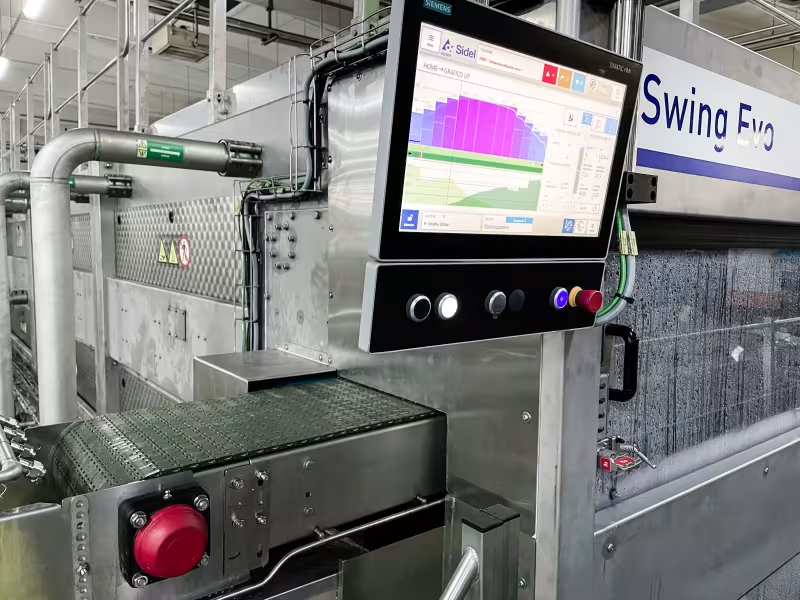
SHERIDAN, WYOMING - March 06, 2026 - Sidel has introduced SWING® Evo, a next-generation tunnel pasteuriser designed to reduce water and energy consumption through a modular architecture and a counterflow concept that enables module-by-module control. The company positions the system as a practical sustainability and cost lever for beverage producers, particularly beer operations running glass and can formats, where pasteurisation performance must stay consistent across changing SKUs and operating conditions. SWING® Evo integrates predictive control to manage product treatment in real time, including during production interruptions. Sidel also points to fast installation and service access as part of the operating case for producers evaluating upgrades or new line projects.
Why tunnel pasteurisation efficiency is becoming an operator priority
Tunnel pasteurisation sits at the intersection of product integrity, line uptime, and utilities consumption. For producers, the constraint is rarely "whether pasteurisation is needed," but whether it can be executed with predictable outcomes while limiting water, electricity, and steam draw across varied production schedules. Sidel's SWING® Evo narrative targets exactly that: lowering consumption through design choices, while preserving operational flexibility in plants that routinely switch between formats, products, and throughput targets.
The release frames SWING® Evo as a "new benchmark" by combining modular design with counterflow operation, and by making utilities control granular at the module level rather than relying on one-size-fits-all settings across the machine.
Core design: modular architecture plus counterflow heat and water circuits
Sidel describes SWING® Evo as using a counterflow configuration and dedicated heat and water circuits to minimize heat dispersion and eliminate unnecessary circulation between tanks. Each module is independently controlled, allowing the system to adapt precisely to production needs. In operational terms, the emphasis is on avoiding wasted circulation and energy losses that can occur when systems run uniformly even when production conditions vary.
The company also highlights simplified integration as part of the architecture story. A compact, modular footprint is positioned to support line designs in both new builds and existing layouts, with the goal of optimizing floor space and simplifying the conveyor path.
Quantified utility reductions and the cost-and-sustainability case
Sidel states that SWING® Evo delivers reductions of 10% in water consumption, 35% in electricity usage, and 10% in steam utilisation. These figures are presented as outcomes of the counterflow configuration, dedicated circuits, and independent module control.
From a buyer standpoint, the operational relevance is that utilities savings can directly translate into lower run-cost per hectoliter (or per packaged unit), while also supporting internal sustainability targets that are increasingly measured and reported. The release positions these reductions as achievable without compromising quality or operational flexibility, which is typically the make-or-break point for pasteurisation investments.
"SWING® Evo pushes the boundaries of sustainability, through introducing true modular efficiency," said Andrea Solfa, Product Manager Tunnel and Site Leader at Sidel. "By ensuring that each module is autonomous and running the top and bottom decks in opposite directions, we have been able to create a pasteuriser that optimises every drop of water and kilowatt of energy with no trade-off on quality."
Process assurance: PRINCE X predictive control and real-time adjustment
Sidel states that SWING® Evo integrates the PRINCE X predictive control system to ensure precise product treatment and eliminate under/over-pasteurisation risks. The release describes a real-time approach: the system automatically analyzes product temperature evolution and adjusts spray conditions in real time, including during production downtimes or power interruptions.
Operationally, this matters because pasteurisation control is not only a quality function; it is also a stability function. When conditions shift-through interruptions, speed changes, or SKU variation-control systems that respond dynamically can help plants avoid rework, prevent quality excursions, and maintain consistent outcomes without building excessive safety margins that waste energy and water.
SKU and format flexibility: glass, can, and operating-mode options
The release positions SWING® Evo as tailored specifically for beer producers and explicitly states support for both glass and can packaging formats. It also frames PRINCE X as enabling "greater format flexibility," allowing optimal settings across a wide variety of SKUs and operating conditions.
Sidel also states the system can operate as a standalone cooler without additional devices or complexity. For plants, this type of flexibility can matter when lines must be repurposed, expanded, or balanced across seasonal production patterns, and when the operating team needs tools that do not add complexity in changeover-heavy environments.
"Every aspect of the design was re-engineered for efficiency," continued Solfa. "From the shorter piping path to the predictive control of cooling media, SWING® Evo proves that less is more."
Integration, commissioning speed, and maintenance access for line teams
Beyond utilities and control, Sidel's release emphasizes deployment and serviceability. It states the first industrial installation at Refresco in Sulmona, Italy confirmed the advantages of compact modular design, and that the pasteuriser was fully assembled and commissioned in just one week due to pre-assembled modules and a streamlined design.
For production engineering and maintenance leaders, time-to-commission and day-to-day access are operational variables that influence total cost, not just convenience. Sidel describes functional access features intended to speed interventions and improve working conditions: sliding lateral doors, full top access, and tool-free maintenance, with components such as pumps, valves, and probes designed to be easy to reach, inspect, and service.
For buyers assessing fit, the release implies an evaluation checklist focused on operating realities:
- Module autonomy and how settings are controlled per module
- Utility consumption impact versus current tunnel pasteuriser baselines
- Control behavior during interruptions and restarts
- Practical SKU/format setup and change management
- Maintenance access and intervention speed under typical plant constraints
"SWING® Evo is a striking illustration that innovation doesn't always mean reinventing everything," concludes Solfa. "Sometimes, the smartest solutions are those that make complexity simple and efficiency effortless."