Autonomous Systems

Blue Ops, FAU Launch Maritime Defense Hub at Harbor Branch

Boca Raton, Fla. – October 02, 2026 -- Florida Atlantic University and Blue Ops, the maritime division of Red Cat Holdings, Inc. (Nasdaq: RCAT), have signed a strategic partnership placing uncrewed maritime systems operations at FAU's Harbor Branch Oceanographic Institute in Fort Pierce.

Blue Ops gains a 144-acre deep-water testing site for uncrewed surface vessels

The agreement grants Blue Ops access to Harbor Branch's secure, 144-acre deep-water port, waterfront infrastructure and marine engineering staff to develop, test and evaluate uncrewed surface vessels, mission systems and open architectures. Activities will include engineering, land- and water-based demonstrations, personnel training, and equipment maintenance and support.
Seasats Deploys Lightfish USV Fleet to Gulf of America Border Mission

Image
Seasats Deploys Lightfish USV Fleet to Gulf of America Border Mission

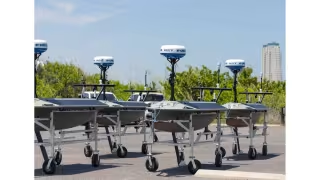
San Diego – October 02, 2026 -- Seasats has deployed a fleet of Lightfish unmanned surface vessels into the Gulf of America for persistent maritime border surveillance, expanding a federal autonomous maritime program run under the Office of the Assistant Secretary of War for Homeland Defense and Americas Security Affairs.

Lightfish fleet launches from Texas coast into Gulf waters

Launched from the Texas coast, the autonomous fleet will conduct continuous surveillance to detect drug trafficking and unauthorized vessel incursions in the Gulf, building on the company's prior support of Operation River Wall along the southern border.

Vatn Systems' SIGURD Wins DIU Mine Countermeasure Prize Challenge

Image
Vatn Systems' SIGURD Wins DIU Mine Countermeasure Prize Challenge

Bristol, R.I. – – October 01, 2026 -- Vatn Systems has won the Department of War Innovation Unit's (DIU) Mine Counter Measure Modernization Prize Challenge, with its SIGURD system ranking among the top performers in the Near Surface and Volume Mine Engage Test and Evaluation segment.

SIGURD neutralized mine threats under real mission conditions during DIU evaluation

The system, built on Vatn's Skelmir S6 platform, autonomously detected, reacquired and neutralized mine threats in scenarios designed to replicate field conditions. DIU opened the challenge in May 2026 to identify modular, communication-resilient, and rapidly fieldable technology for underwater mine threat reacquisition and neutralization.

Navy Doubles MQ-25A Stingray Carrier Fleet in Five Months

Image
Navy Doubles MQ-25A Stingray Carrier Fleet in Five Months

Palmdale, Calif. – September 30, 2026 -- The U.S. Navy has doubled its fleet capacity to operate the MQ-25A Stingray unmanned aircraft system over a five-month period, standing up a second operational MD-5C Ground Control Station powered by Lockheed Martin's Skunk Works MDCX autonomy platform.

USS Ronald Reagan joins USS Theodore Roosevelt as second carrier ready to fly the Stingray

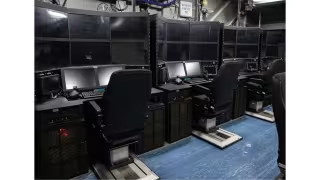
USS Theodore Roosevelt (CVN 71) received the first operational MD-5C in March 2026, followed by USS Ronald Reagan (CVN 76) in August 2026. The MD-5C, installed in the Unmanned Air Warfare Center aboard each carrier, functions as the dedicated onboard command center for unmanned carrier aviation, combining a government Command, Control, Communications, Computers and Intelligence network with Lockheed Martin's MDCX software and hardware and additional government-produced ancillary equipment.

Advantech Unveils ASR-D501 AI Computer for Autonomous Drones

Image
Advantech Unveils ASR-D501 AI Computer for Autonomous Drones

Taipei – – September 30, 2026 -- Advantech has launched the ASR-D501, a compact AI companion computer built to power autonomous unmanned aerial vehicles, delivering up to 12 TOPS of AI performance within a sub-10W power envelope.

Qualcomm QCS6490 chipset enables onboard AI processing without constant cloud reliance

The ASR-D501 runs on the Qualcomm QCS6490, combining CPU, GPU, and NPU compute to handle object detection, semantic segmentation, visual inspection, obstacle awareness, vision-based localization, and sensor-fusion tasks directly on the drone. By offloading perception and mission-level workloads from the flight controller, the platform lets the primary controller focus exclusively on flight stabilization and actuator control. Supported navigation capabilities include VIO, SLAM, and GNSS-denied operation.