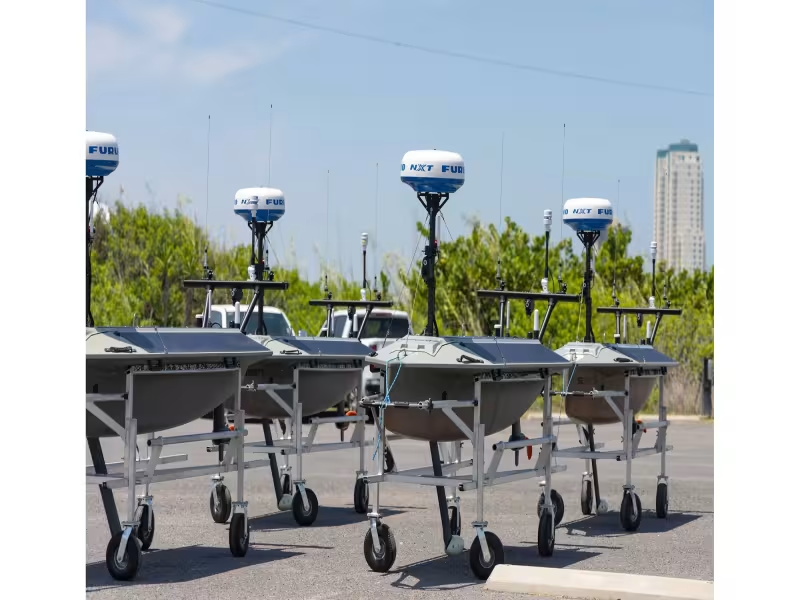
San Diego – October 02, 2026 -- Seasats has deployed a fleet of Lightfish unmanned surface vessels into the Gulf of America for persistent maritime border surveillance, expanding a federal autonomous maritime program run under the Office of the Assistant Secretary of War for Homeland Defense and Americas Security Affairs.
Lightfish fleet launches from Texas coast into Gulf waters
Launched from the Texas coast, the autonomous fleet will conduct continuous surveillance to detect drug trafficking and unauthorized vessel incursions in the Gulf, building on the company's prior support of Operation River Wall along the southern border.
Rio Grande operations since January 2026 precede Gulf expansion
Since January 2026, Lightfish vessels have operated on the Rio Grande alongside crewed patrol assets, providing surveillance and early warning in a riverine environment that had not previously seen sustained unmanned surface vessel operations. The Gulf deployment extends that mission into open water.
Solar-powered 11-foot vessels hold station for months without a crew
Each Lightfish measures roughly 11 feet in length and weighs 340 pounds, runs on solar power, and is built for multi-month endurance on station. Two people can launch and recover a unit from a boat ramp or the back of a pickup truck. A modular payload bay has carried electro-optical and infrared cameras, signals payloads, and sonar across prior missions, letting a single hull configuration be adapted to different sensing tasks.
"The Gulf is too vast to monitor with crewed hulls alone. Traditional patrols burn fuel, have high hourly costs, and can only stay out as long as the people on board. A Lightfish is solar powered and has no one aboard, so it can hold station for months in conditions where you wouldn't want to put a crew. With a fleet of them working together, we get continuous coverage of an area that has only previously been seen in snapshots,