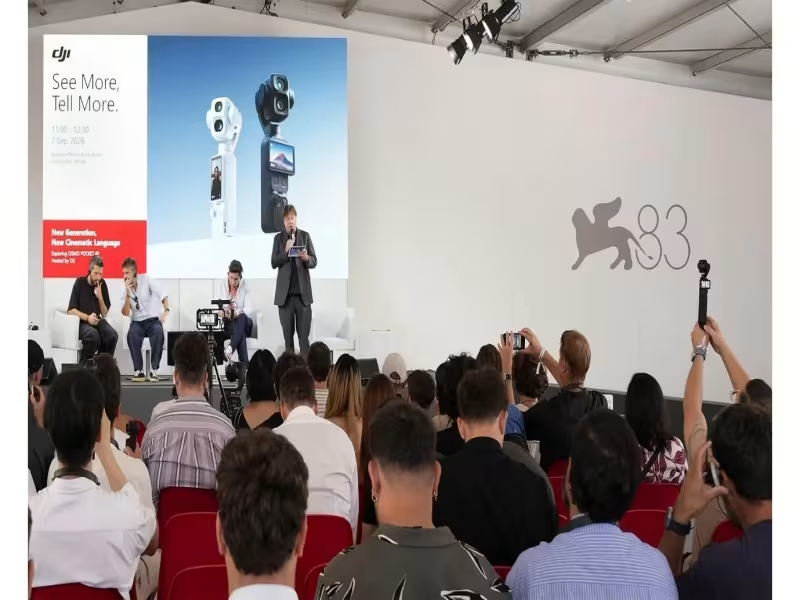
Venice – September 13, 2026 -- DJI staged a professional forum titled the "Filmmakers & Visionaries Session" at the Venice Production Bridge during the 83rd Venice International Film Festival, using the event to argue that its pocket-sized Osmo Pocket 4P camera can meet the technical standards of professional cinema.
DJI links Cannes and Venice campaigns around one camera
The Venice session extended a creative campaign DJI began in Cannes in May, when it handed the Osmo Pocket 4P to two filmmakers working independently on different continents. Actress and director Isabelle Huppert used the device to shoot "FAMILIARITÉ," a meditation on literature and memory, while Japanese cinematographer Mikiya Takimoto used it to shoot "Looking for Her," a road-movie narrative set in a historic silver-mining town. Both projects were filmed entirely on the Osmo Pocket 4P.
Four short films from four countries anchor the industry dialogue
DJI structured the Venice session as a filmmaking dialogue rather than a product launch, screening four short films from emerging cinematographers: Gabriele Mencaroni and Alessandro Tempestini of Italy, Liu Yadi of China/France, and Zhou Chengzhou of China/Netherlands. The works spanned experimental film, advertising production and festival-recognized documentary.
Three award-winning cinematographers reviewed the work against professional benchmarks
Following the screening and a live shooting demonstration, three established cinematographers delivered professional critique: Valentin Vignet, known for "Faces Places" and the Oscar-nominated short "Nefta Football Club"; Cristiano Di Nicola, whose film "L'Estranea" competed in Venice's Official Competition this year; and two-time David di Donatello winner Michele D'Attanasio, credited on "Veloce come il vento," "Freaks Out" and "L'ombra di Caravaggio." All three assessed the emerging filmmakers' work against large-scale production standards.
Di Nicola said none of the filmmakers had to compromise on quality by using a lightweight camera, adding that the Osmo Pocket 4P allowed shots he previously thought impossible and let crews focus on storytelling rather than equipment setup.
Roundtable debates whether lighter equipment is reshaping cinematic language
A closing roundtable, "How is a new generation of technology reshaping cinema?", examined four questions: how compact, gimbal-stabilized tools change the relationship between camera, performer and environment; whether lighter equipment democratizes professional filmmaking while demanding stricter visual discipline; how lightweight setups alter on-set production dynamics; and whether a product can change cinematic language itself, or whether the creative vision must always come first.
Panelists noted that removing large camera rigs changes the on-set dynamic, with performers no longer adapting to equipment and the camera functioning as an observer rather than an obstacle. Cinematographers working across China, France and the Netherlands framed the shift in terms of professional standards -- color science, dynamic range and stabilization precision -- becoming decoupled from equipment size, allowing a single operator in a confined space to apply techniques previously associated with larger crews.
DJI positions the Osmo Pocket 4P as cinema-grade tool for individual operators
DJI framed the session around a shift in industry questioning, from "what equipment do we need" to "what becomes possible once equipment is no longer a constraint." The company presented the Osmo Pocket 4P as enabling professional-grade imaging for individual operators shooting in constrained environments, from urban settings to remote outdoor locations.