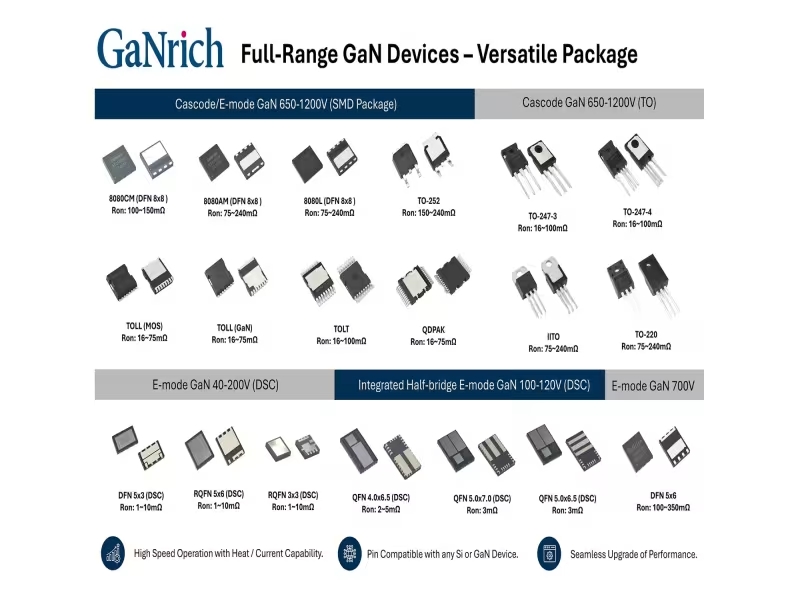
TAIPEI – November 05, 2026 -- Taiwan-based GaNrich Semiconductor has built a gallium nitride (GaN) power device portfolio covering 40V to 1200V on both GaN-on-Si and GaN-on-Sapphire platforms. The company says it is currently the only GaN designer able to supply mass-production GaN product for customer validation in Taiwan.
GaNrich covers low-mid and high voltage ranges for AI data centers and EVs
The 40V-250V line targets applications where traditional silicon devices have reached their performance limits. GaNrich has completed development of 5x6, 5x3 and 3x3 packages that are compatible with existing standard silicon devices. It also integrates gate drivers into the same package to simplify circuit design.
The 650V-1200V devices address high-power AI data center power supplies, AC-DC conversion and electric vehicles. They offer pin-to-pin drop-in replacements for traditional silicon components. Target uses for the full range also include Backup Battery Units, robotics, drones and On-Board Chargers.
GaNrich plans a 1200V bidirectional switch to enter silicon carbide territory
GaNrich plans to launch a 1200V bidirectional switching (BDS) product. The company says it reduces system component count, increases voltage design margin and enables single-stage power-conversion architectures. The move targets application segments currently served by silicon carbide (SiC).
Non-red supply chain targets European and U.S. demand for alternatives
GaNrich states that the global GaN market is currently highly concentrated in China-based supply chains, while European and U.S. customers still have new in-house capacity demands. The company coordinates Taiwan GaN wafer manufacturing and packaging resources with global partners to offer what it calls a non-red supply chain option.
GaNrich also offers mask design, advanced packaging, system module integration and reliability testing. Selected products have been validated by leading global customers in automotive, energy storage and industrial applications, according to the company. It did not disclose customer names, volumes or revenue.