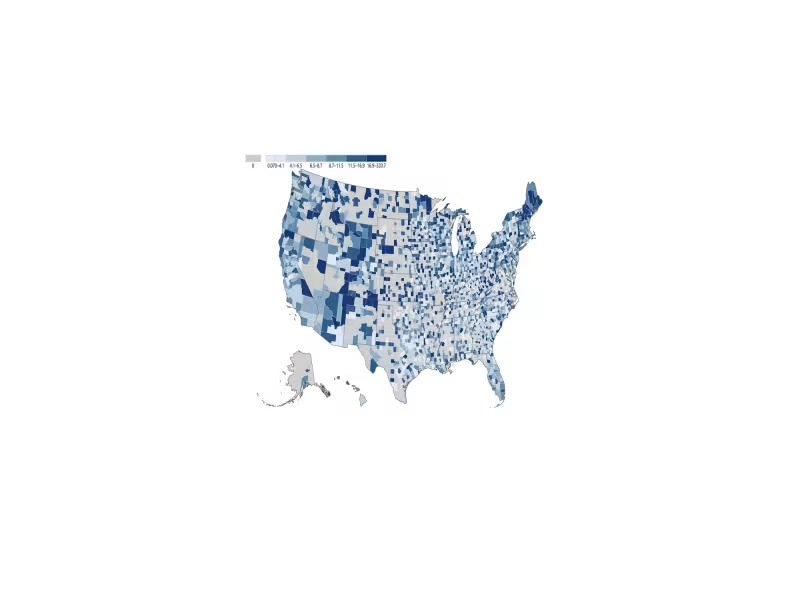
Washington – September 28, 2026 -- More than 15 million Americans live in one of 1,180 US counties with no general surgeon, according to a national analysis unveiled at the ACS Clinical Congress 2026 and published simultaneously in the Journal of the American College of Surgeons.
Study maps 12 surgical specialties across all 3,144 US counties for the first time
The American College of Surgeons (ACS) and the Cecil G. Sheps Center for Health Services Research at the University of North Carolina at Chapel Hill identified 201,394 surgeons practicing nationwide as of April 2025, equal to 59.2 surgeons per 100,000 people. Of the country's 3,144 counties, 951 (30%) had no identified surgeon in any of the 12 specialties, affecting 9.6 million people, while 1,180 counties (38%) had no general surgeon, affecting 15.1 million.
Surgeon density varies twelvefold between regions
Across all 306 hospital referral regions, every region had at least one general surgeon, but overall specialty surgeon supply ranged from 20.8 per 100,000 people in Harlingen, Texas, to 250.4 in Rochester, Minnesota. Transplant surgery, the most concentrated specialty at 0.3 surgeons per 100,000 people, was absent from 179 of the 306 referral regions.
434 critical access hospitals operate without a local full-time surgeon
Researchers overlaid surgeon locations with federal facility data and found 475 hospitals and surgical facilities situated in counties lacking an identified full-time surgeon. Of those, 434 were critical access hospitals, the small rural facilities that many communities depend on for emergency and inpatient care.
Interactive tool lets policymakers and hospitals query county-level workforce gaps
The ACS Surgical Workforce Mapping Tool, built on the same dataset, lets hospital boards, residency program directors, state legislators, congressional staffers, and patients look up, compare, and download surgical workforce data by county, referral region, or metropolitan/micropolitan area. Users can filter by specialty, overlay hospitals and ambulatory surgical centers, and export maps for reports.
Thomas C. Tsai, MD, MPH, FACS, Medical Director for Health Policy Research in the ACS Division of Advocacy and Health Policy, said national averages can mask sharp differences between communities in whether a surgeon is actually available nearby.
Pending federal legislation would formalize shortage-area methodology
The Ensuring Access to General Surgery Act of 2026 (H.R. 7198) would direct the Health Resources and Services Administration to develop a methodology for designating general surgery shortage areas based on surgeon supply and geographic service areas. The study's authors note that the choice of geographic scale is critical: every hospital referral region had a general surgeon, yet 1,180 individual counties did not.
The analysis draws on April 2025 National Plan and Provider Enumeration System data and Q2 2025 CMS Provider of Services files, and does not measure patient travel time, surgical volume, or hospital affiliation of individual surgeons.