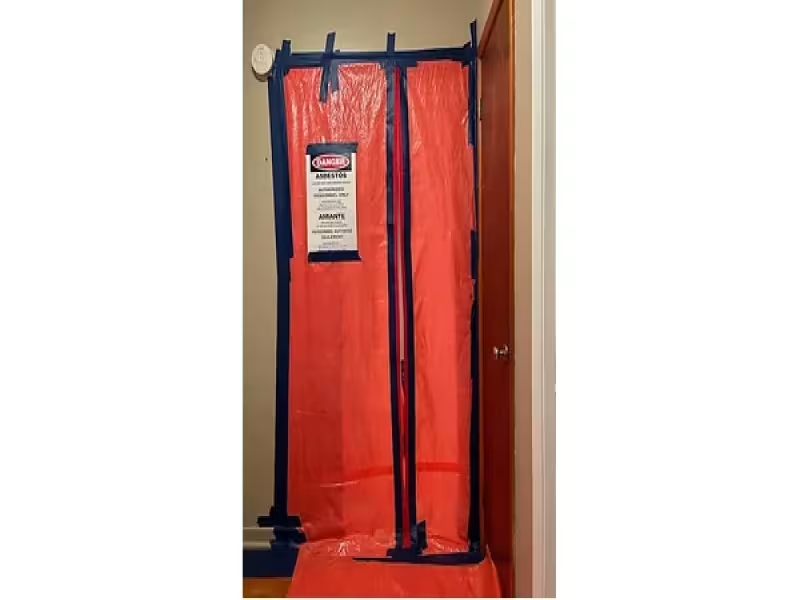
Ottawa – September 22, 2026 -- Nearly 60% of Ottawa's occupied private dwellings were built in 1990 or earlier, placing them squarely within the era when asbestos was commonly used in construction, according to a housing-age analysis published by PatchBoyz Asbestos Removal. Statistics Canada's 2021 Census counts 243,080 of Ottawa's 407,250 occupied private dwellings as built in 1990 or earlier, equal to 59.7%.
Census data confirms 243,080 Ottawa dwellings predate the 1990 asbestos cutoff
The breakdown shows 64,815 dwellings built in 1960 or earlier, 115,070 from 1961 to 1980, and 63,195 from 1981 to 1990. A further 179,885 dwellings, or 44.2% of the city's occupied housing, were built in 1980 or earlier, capturing what the analysis identifies as the peak decades of asbestos use in North American construction. Health Canada's asbestos-in-the-home guidance, published March 19, 2026, states asbestos was mainly used before 1990 for insulation, fireproofing, and noise reduction, and may remain in cement, plaster, floor and ceiling tiles, insulation, and heating systems.
Ontario Regulation 278/05 mandates pre-project asbestos examination
Ontario Regulation 278/05 requires owners to have an asbestos examination and report prepared before arranging for demolition, alteration, or repair work that could disturb suspect material. The requirement covers both friable and non-friable asbestos-containing materials and extends to electrical, plumbing, heating, and air-handling equipment, including rigid ductwork. The City of Ottawa's 2026 emergency-repair guidance separately advises that properties built before 1990 may contain asbestos and recommends professional checks before repair or demolition.
Federal ban on new asbestos leaves legacy materials in older buildings
Canada's Prohibition of Asbestos and Products Containing Asbestos Regulations, in effect since December 30, 2018, bar the import, sale, and use of new asbestos-containing products. The ban does not extend to materials already installed, meaning asbestos in pre-1990 Ottawa homes remains a disturbance risk during renovation, alteration, or demolition work.
Multiple building materials fall under Health Canada's asbestos-risk list
Health Canada's guidance flags popcorn or stipple ceilings, drywall joint compound, floor and ceiling tiles, plaster around walls and pipes, loose-fill insulation, pipe wrap, and furnace ductwork or vents as potential asbestos sources in homes built before the 1990s. A single renovation project may involve several of these material types, each requiring distinct handling and disposal protocols under Ontario regulation.
PatchBoyz frames its service model around coordinating asbestos assessment, abatement, and restoration through a single contractor relationship, arguing this reduces scheduling gaps between specialist disciplines and lowers the risk of project delays tied to mid-renovation asbestos discoveries. Statistics Canada's construction-period data does not confirm asbestos presence in any specific property; professional assessment remains required under Ontario Regulation 278/05.