Brilliant Earth Moves Analytics Into Snowflake, Retires Legacy BI

United States – – October 27, 2026 -- Brilliant Earth has moved more than 100 showroom operations users off a legacy BI platform and onto Posit dashboards running natively inside Snowflake, cutting software license costs while widening self-serve access to governed data.

The luxury jewelry retailer already reprices its diamond inventory daily through an automated model running in Snowflake. That capability prompted the company to adopt the platform. Weekly data science reports captured only moments in time, so Brilliant Earth set out to give decision-makers direct access to the same data and models.

Posit Team runs as a Snowflake Native App on Snowpark Container Services

Brilliant Earth installed Posit Team inside Snowflake instead of maintaining a separate server with its own security protocols. Snowflake roles, user permissions and table access now govern Posit as well.


Vivix Pilots AI Furnace Twin to Cut Energy Use 3%-5%

Image
Vivix Pilots AI Furnace Twin to Cut Energy Use 3%-5%

Brazil – October 27, 2026 -- Brazilian flat glass maker Vivix expects to cut furnace energy consumption by 3%-5%, extend furnace lifespan by one year and shorten its data collection and analytics cycle by 80%, based on a pilot of an executable digital twin (xDT) built with Siemens, Snowflake and NVIDIA.

Vivix targets blind spots in 1,550°C-1,600°C float-glass furnaces

The furnace is one of the most critical and hardest-to-observe assets in float-glass production. At operating temperatures of roughly 1,550°C to 1,600°C, teams have limited direct visibility into how combustion gases, molten glass and refractory walls interact. Vivix supplies glass and mirrors to the construction and furniture markets.

Meta Prices $25B Stock Offering, $12.5B Mandatory Convertible Deal

Image
Meta Prices $25B Stock Offering, $12.5B Mandatory Convertible Deal

MENLO PARK – October 27, 2026 -- Meta Platforms raised the size of its Class A common stock offering to $25.0 billion from $22.5 billion and priced a parallel offering of 6.50% mandatory convertible preferred stock expected to net about $12.5 billion.

Meta sells 250 million depositary shares at $50 each

The depositary shares each represent a 1/20th interest in a share of newly issued 6.50% Series A Mandatory Convertible Preferred Stock. Underwriters hold a 30-day option on up to 37,500,000 additional depositary shares, which would lift net proceeds to about $14.3 billion. Meta plans to use the money for general corporate purposes.

The preferred stock carries a $1,000 liquidation preference per share. Dividends accumulate at 6.50% annually and are payable on February 15, May 15, August 15 and November 15, starting February 15, 2027. Meta can pay them in cash, in Class A common stock or in a combination of the two.

EBA Outlines EU Mandate: Bank Rules, Risk Monitoring, Data Disclosure

EU – October 27, 2026 -- The European Banking Authority (EBA), an independent EU authority, describes its core remit as safeguarding the integrity and robustness of the EU banking sector to support financial stability.

EBA develops harmonised rules and promotes supervisory convergence

The authority writes harmonised rules for financial institutions and promotes convergence of supervisory practices. It also monitors and advises on the impact of financial innovation and the transition to sustainable finance.

EBA monitors risks for banks and investment firms through reporting and disclosure

To keep the EU financial system orderly and stable, the EBA monitors and analyses risks and vulnerabilities relevant to the regulation of banks and investment firms. It facilitates information sharing among authorities and institutions through supervisory reporting and data disclosure.

Dust CTO Pitches Company-Owned AI to Curb Model Vendor Lock-In

Image
Dust CTO Pitches Company-Owned AI to Curb Model Vendor Lock-In

Global – October 27, 2026 -- Dust, a collaborative AI platform, is targeting three forms of enterprise AI dependency: reliance on a single model provider, loss of control over agent-generated data, and limited visibility into costs and behavior, according to Co-Founder and CTO Stanislas Polu.

Dust builds a shared layer between staff, company data and multiple models

Polu said Dust lets teams work with AI, switch among supported frontier and open source models, and govern the context, agents and traces their work generates. The platform is multimodel by design, so companies can change models without rebuilding their context and workflows.

Polu argues that agent traces, which record instructions, context, model and tool choices, outputs and human feedback, may become one of a company's most valuable AI assets. He said that corpus could later help companies evaluate or train models for their specific work.

Snowflake Sets Out Ground-Analyze-Act Framework for AI Agents

Image
Snowflake Sets Out Ground-Analyze-Act Framework for AI Agents

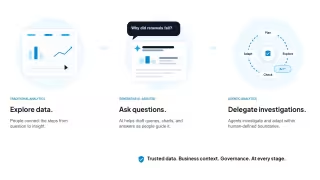
Global – October 27, 2026 -- Snowflake is built around three pillars, Ground, Analyze and Act, wrapped in a governance layer it calls Assure, to let AI agents run open-ended business investigations on enterprise data without copying that data into each agent platform.

The model targets agents that decide which data to examine, learn from each result and choose the next step. A churn probe, for example, could compare customer segments, product usage and support issues, then feed a recommended response into a retention workflow.

Multnomah County Completes Legacy Data Migration in Five Months

Image
Multnomah County Completes Legacy Data Migration in Five Months

Portland – October 27, 2026 -- Multnomah County, Oregon, migrated a decade-old SQL Server environment to a modern data platform in five months, a timeline that public sector organizations often stretch over years, according to a session at this year's Snowflake Summit.

Multnomah County replaces undocumented SQL Server estate with AI-assisted migration

The county's legacy environment spanned dozens of business intelligence workloads and had been built by engineers who had since left. Documentation was sparse, the architecture was inconsistent and costs were climbing.

ESMA flags geopolitical risk and restructuring in 2026 priorities

Europe – October 27, 2026 -- The European Securities and Markets Authority (ESMA) has named geopolitical risks and uncertainties, and restructuring provisions and debt restructuring, as enforcement focus areas for listed issuers' 2026 annual financial reports under its European Common Enforcement Priorities (ECEP).

ESMA sets three reporting areas for 2026 annual reports

The ECEP cover IFRS financial statements, sustainability statements under the European Sustainability Reporting Standards (ESRS) and European Single Electronic Format (ESEF) digital reporting.

For IFRS financial statements, the two priorities are geopolitical risks and uncertainties, and restructuring provisions and debt restructuring.

EU Regulators Name DORA, AI and Securitisation 2027 Priorities

EU – October 27, 2026 -- The Joint Committee of the European Supervisory Authorities (EBA, EIOPA and ESMA) has published its Annual Work Programme for 2027. It lists digital operational resilience, technological innovation, sustainable finance, securitisation and cross-sectoral risk monitoring as the five key priorities for the EU financial sector.

ESAs continue DORA oversight of critical ICT third-party providers

Under the Digital Operational Resilience Act (DORA), the three authorities will continue oversight of critical ICT third-party service providers. They will also work to strengthen the financial sector's preparedness against cyber threats. Financial institutions that depend on external technology vendors remain within the supervisory scope.

ESMA Updates Transparency Manual for OTC Derivatives, Tick Sizes

European Union – October 27, 2026 -- The European Securities and Markets Authority (ESMA) has updated its transparency manual with new guidance on identifying over-the-counter (OTC) derivatives subject to transparency requirements and on applying the tick-size regime.

ESMA specifies how OTC derivatives reference data must be supplied

The update clarifies how identifying reference data for OTC derivatives should be provided for transparency purposes. ESMA aims to make the data reported to, and published through, the consolidated tape more consistent.

The guidance on OTC identifying reference data remains a draft until the related technical standards enter into force: RTS 2 and the RTS on CTP input/output data.