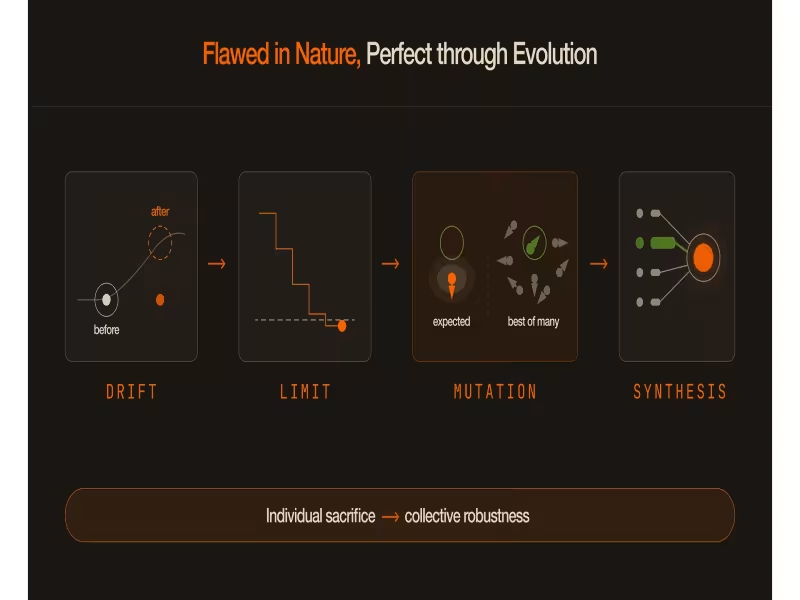
New York – September 07, 2026 -- Allora Labs has published mathematical proof that introducing targeted random mutations into a population of AI models allows the group to collectively outperform any single optimized model once operating conditions shift. The paper, authored by Chief Scientist Dr. Diederik Kruijssen and titled "Flawed in Nature, Perfect through Evolution," appears in Volume 3 of the journal Allora Decentralized Intelligence, spanning pages 1-32 and published September 2, 2026.
Best model in a mutated swarm beats optimized rivals in 80% of test cases
The research demonstrates that while each individually mutated model performs worse on its own, the top performer within a mutated swarm outperforms the best model in a non-mutated, fully optimized swarm approximately 80% of the time once conditions change. Four mathematical theorems establish that no single model can exceed a fixed information-theoretic performance ceiling, while a mutated population provably breaks through it. Numerical experiments confirmed all four theorems with high statistical significance.
"Every single AI model, no matter how well trained, accumulates errors once the world it was trained on changes," said Dr. Kruijssen. "We prove that a population of deliberately diversified models breaks through that ceiling for the same reason biological species survive environmental shifts: they already carry pre-existing variation, some of which happens to fit the post-change world."
Optimal mutation rate tracks environmental change rate across a 100x tolerance band
The performance advantage peaks when model mutation rates roughly match the rate of environmental change, a "Goldilocks zone" mirroring evolutionary dynamics in nature. The tolerant range spans roughly a hundred-fold around this peak, with minimal penalty for under-mutation and severe degradation only when mutation rates run too high, a finding Allora Labs says opens practical deployment paths for volatile domains like financial markets, healthcare, and autonomous vehicles.
Prof. Steven Longmore of Liverpool John Moores University, working on AI-driven biodiversity conservation, said formalizing the link between individual imperfection and collective adaptation with mathematical guarantees for artificial systems marks a significant step, offering a new lens on AI robustness under changing conditions.
Allora Labs CEO frames model-population dynamics as the next AI research frontier
"The inability to adapt to changing conditions has become AI's primary failure mode as these systems get deployed in constantly shifting environments," said Nick Emmons, CEO of Allora Labs. "Most AI research focuses on making individual models bigger and faster. We believe the larger gain lies in how populations of models interact and evolve, and this work proves that's the right lens."
The paper outlines follow-on research directions including applying the "Flawed-in-Nature" principle to large language models via fine-tuning methods, extending it to decentralized AI networks, and building a control algorithm that automatically adjusts mutation strength without requiring knowledge of environmental change. Dr. Kruijssen said his team has already built the controller needed to implement the principle in practice and started work on several concrete applications. The paper is available via DOI 10.70235/allora.0x30001 and arXiv:2609.00129.