STUTTGART -- November 24, 2026 -- Baden-Württemberg has provided for BIM on new federal road projects since March 2026, but routine use across all project types, administrative levels and companies has not yet been reached, according to Nicolai Nolle of viscan GmbH. The state plans to make the method standard on state roads from 2027.
By our calculation, the federal-road regime is about eight months old, and the state-road step falls no earlier than about five weeks from today. Contractors, engineering firms and road administrations face a second BIM obligation within a year, and the release says their experience levels still differ widely.
Baden-Württemberg built its BIM rules before the rollout began
The state's BIM strategy and its BIM-Leitfaden 2.0 set the organisational and methodological basis for regular BIM operation in the road construction administration. Transport Minister Nicole Razavi visited the BIM LÄB during her summer tour. Nolle says the talks covered qualification hurdles, uniform workflows, data standards and responsibilities.
Nolle says the next step is to standardise successful approaches, scale them and anchor them in regular project workflows. He argues that a 3D model alone does not make a digital construction process. In his view BIM is a form of information and project management that depends on clear responsibilities and qualified staff.
viscan has run the BIM LÄB for three years and trains several hundred people annually
viscan GmbH has been the official operator of the BIM LÄB Baden-Württemberg for three years, which by our calculation puts the start at about 2023, well before the federal-road requirement took effect. The company says several hundred people attend training sessions, demonstrations and specialist events there each year. Topics include buildingSMART-standard BIM basics, BIM management, digital approval processes, model-based tendering and billing, and progress capture.
The target groups are administrations, engineering firms, contractors and project managers. Nolle says the lab is not a product showroom. It is meant to show which solutions suit which use cases and where further development or testing is needed.
On site, contractors can use model-linked data to compare actual progress with the design, track executed quantities and support model-based billing, according to the company. The technical basis is common data environments, with the open formats IFC for data exchange and BCF for model-related communication.
AI use depends on data quality and unresolved rights questions
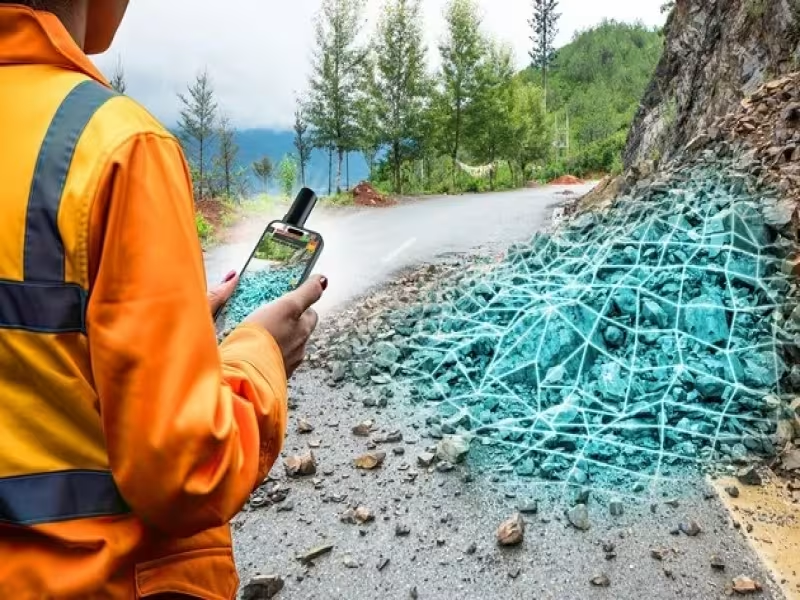
Drone surveys, mobile laser scans and smartphone capture can already deliver current as-built and progress data in real projects, the company says. In clearly defined use cases, AI can detect objects and changes in image or point-cloud data and flag anomalies for review.
Before such tools scale, the purpose, accuracy and currency of the data, and who reviews and releases results, must be defined. Data protection, information security, and ownership, copyright, usage and access rights to image, model and training data also need clarifying. Nolle says professional responsibility for safety-relevant structures cannot pass to an AI system.
He sees the next step as deploying defined AI applications under real conditions, checking their results measurably and training staff to use them. The company did not disclose how many federal-road projects now use BIM.