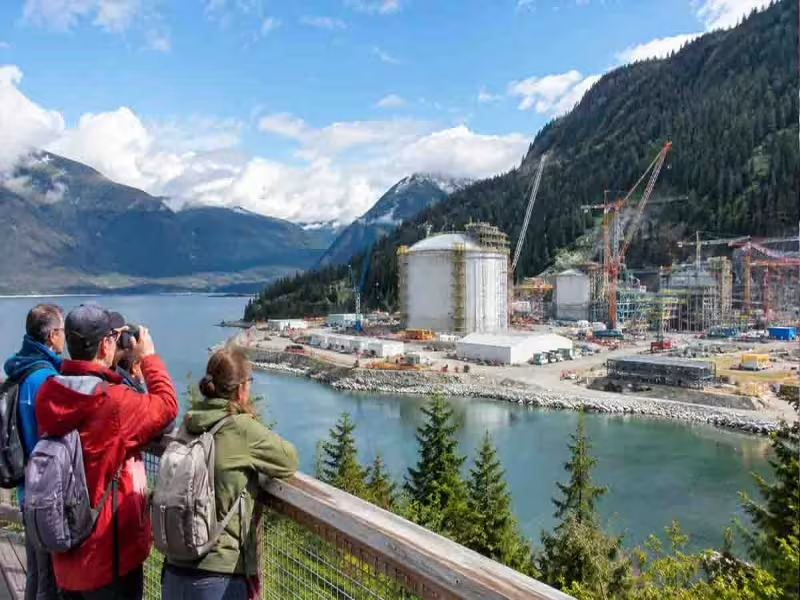
SQUAMISH -- November 20, 2026 -- Canada will invest $200 million in the Woodfibre LNG project in Squamish, British Columbia, Energy and Natural Resources Minister Tim Hodgson announced. The money supports a higher output target for the export plant, which was designed for 2.1 million tonnes of liquefied natural gas a year and now aims for 2.5 million to 2.6 million tonnes.
That is 0.4 million to 0.5 million tonnes more annually, an increase of about 19% to 24% by our calculation. The federal funding is also meant to improve the plant's operational reliability and efficiency, according to the announcement. The government did not disclose whether the $200 million is a grant, a loan or an equity stake.
Woodfibre LNG raises its capacity target above the original 2.1 million tonnes
The higher range is a proposed figure, not a commissioned capacity. The facility is scheduled to open in 2027. The expansion is tied to Canada's stated aim of diversifying trade away from the United States, in particular by exporting more energy to Asian markets.
The project is being advanced with the Squamish Nation. Its approval followed what the announcement describes as Canada's first non-treaty, Indigenous-led environmental assessment for a major industrial development. The resulting agreement sets 25 legally binding conditions on environmental protection and oversight.
Construction crews of 1,500 a day will give way to about 100 permanent jobs
About 1,500 workers are expected on site each day during construction. Once the plant operates, it is expected to support roughly 100 permanent jobs. By our calculation, that is a ratio of 15 to 1, and the permanent workforce equals about 7% of the construction-phase headcount.
Suppliers and service providers in the Squamish area therefore face a demand peak tied to the build period. The announcement says the effect on local accommodation and services depends on housing arrangements and purchasing patterns, which it does not specify. It also says the investment contains no dedicated tourism programme.
Developer puts emissions intensity about nine times below the global LNG average
Woodfibre LNG will power its gas liquefaction with British Columbia hydroelectricity. According to the developer, the facility's projected emissions intensity is about nine times lower than the global average for LNG export plants.
The company plans to reach net-zero emissions from the start of operations, using operational measures and carbon offsets for residual emissions. These commitments cover the facility's own emissions accounting. They do not cover emissions elsewhere in the natural gas supply chain.