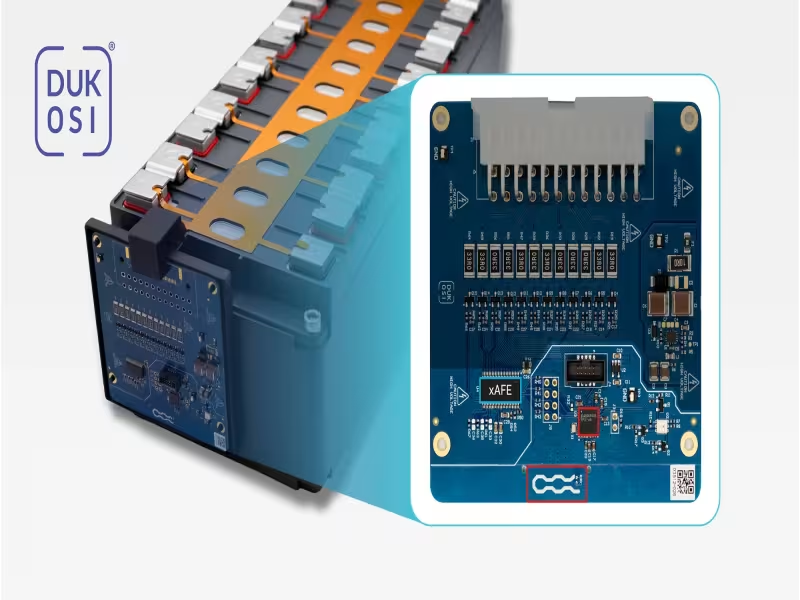
Edinburgh, Scotland – – September 29, 2026 -- Dukosi Ltd has moved its DK-NFLNK contactless communication solution from proof-of-concept to full product availability, opening customer sampling and evaluation kits for battery developers across electric vehicles, industrial, marine, robotics, energy storage, telecom infrastructure and AI data center applications.
Dukosi ships DK-NFLNK samples and evaluation kits to key customers
The solution, first shown as a proof-of-concept at embedded world in March, is now available for battery system design work. It targets manufacturers using traditional multi-channel analog front end (AFE) architectures who want to eliminate wiring and connector failure points without redesigning battery hardware.
Technology replaces wired BMS links with single-antenna contactless network
DK-NFLNK is built around the DK8503 Node chip, the DK8203 System Hub chip, a Dukosi API and a proprietary contactless protocol based on C-SynQ. The DK8503 Node connects to any AFE via standard SPI, making the system AFE-agnostic, while data moves to and from the BMS host processor through the DK8203 System Hub over a single bus antenna instead of a multi-wire harness.
Near-field communication keeps RF power levels low, simplifying mechanical integration, and the built-in electrical isolation is designed to deliver wired-like performance in a star-network topology. Both the DK8503 and DK8203 chips are AEC-Q100 certified and designed to ASIL C compliance, targeting automotive-grade safety requirements.
Common hardware and software cut redesign costs across multiple battery platforms
Dukosi says the same BMS host processor and DK8203 System Hub can be reused across different battery pack designs, with a shared DK-NFLNK library and API reducing software development and maintenance work across product lines while keeping RF performance consistent.
President Joseph Notaro frames DK-NFLNK as a bridge to full smart-cell systems
Joseph Notaro, President at Dukosi, said DK-NFLNK and the company's Dukosi Cell Monitoring System (DKCMS) share the same C-SynQ communication foundation, giving battery designers a migration path toward full DKCMS-enabled smart-cell battery designs. He said the company is providing customers a cost-efficient upgrade route from modular architectures toward smart-cell batteries in future.
Evaluation kit bundles hardware, cabling and GUI for rapid integration testing
The DK-NFLNK Evaluation Kit includes a Node board, System Hub unit, an optional resistor divider board, USB, SPI, bus antenna and coaxial cables, a Windows-based GUI, and user and PCB design guides. Dukosi positions the kit for battery pack developers and BMS designers to test integration across a growing range of host processors and AFE devices.