Boston – September 15, 2026 -- Encoura has published a new analysis showing that academic fields outside higher education's most popular majors are drawing sustained student interest but lack the outcomes visibility needed to compete for enrollment. The Eduventures Admitted Student 2026 Trend Report, titled "Beyond the Big Five: Exploring Majors Outside the Mainstream," draws on more than 42,000 responses collected over three years through Eduventures Admitted Student Research.
Report identifies a 'Next Five' tier of academic fields trailing the dominant majors
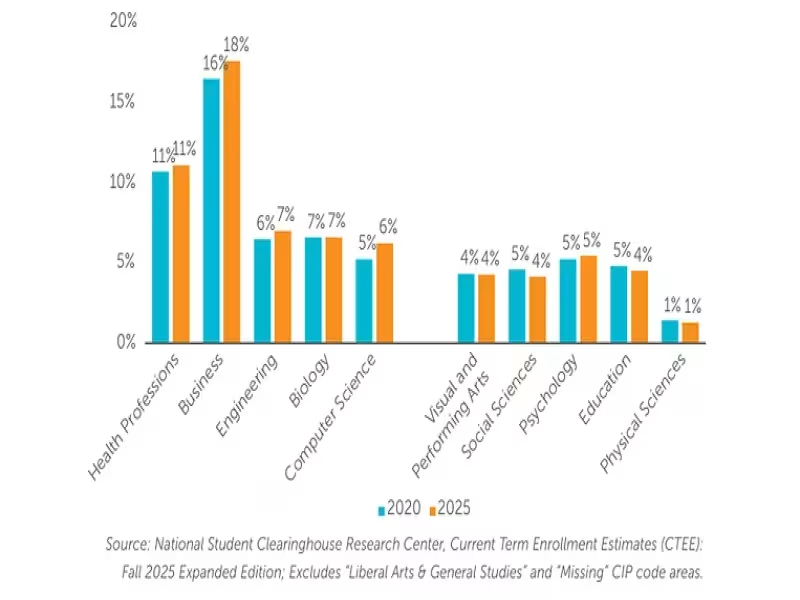
The study defines the "Big Five" fields — Biology, Business, Computer Science, Engineering, and Health Professions — as benefiting from clear career pathways and employer pipelines. It identifies a "Next Five" tier — Visual and Performing Arts, Psychology, Education, Social Sciences, and Physical Sciences — as the next most significant area of admitted-student interest.
Four of five 'Next Five' fields already rank among top 10 enrollment categories
Psychology, Education, Visual and Performing Arts, and Social Sciences all place among the top 10 fields for current student enrollment, according to the report, underscoring their continued weight in institutional academic portfolios despite less visible career pipelines than the Big Five.
Students in these fields define value through impact rather than direct job pipelines
The report finds that students choosing Next Five fields have distinct motivations, expectations, and enrollment drivers, requiring differentiated recruitment and yield strategies. These students are described as outcomes-oriented in their own way, frequently measuring return through human impact, community contribution, and long-horizon careers rather than immediate occupational placement.
Weak career-pathway messaging limits which students consider these majors
Emily Ross, Eduventures senior analyst and the report's primary author, said the challenge for enrollment teams is helping students and families see where these fields can lead and making the value of those pathways as visible as possible. The report argues that inconsistent communication of outcomes stories — compared with the Big Five — narrows the pool of students who can picture themselves in these careers.
Report calls for stronger alumni, employer, and faculty-mentorship visibility
Encoura recommends institutions build sharper narratives around fields lacking an obvious career pathway by surfacing alumni outcomes, employer partnerships, faculty mentorship, graduate school placement, and varied career destinations to prospective students. The report also stresses that storytelling alone cannot manufacture an outcomes advantage; institutions must first build the student-success infrastructure and pathways that produce measurable outcomes before promoting them.