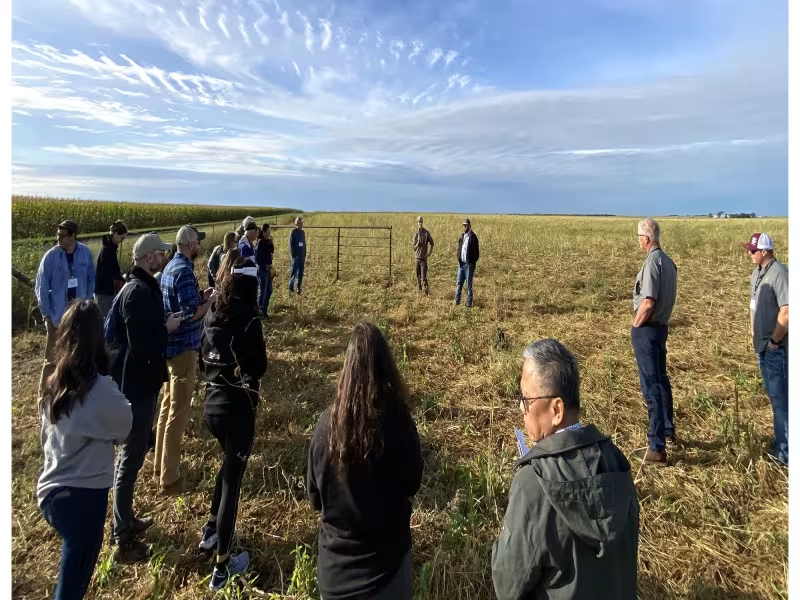
Westminster, Colo. – October 01, 2026 -- Roughly 40 agricultural, regulatory and conservation specialists completed the third annual Endangered Species Act (ESA) Farm Tour September 14-16 across Minnesota and South Dakota, examining how pesticide-use rules and precision agriculture can coexist with species protection efforts.
Federal agencies joined researchers and crop consultants for three days of field assessments
The tour, hosted by the National Alliance of Independent Crop Consultants (NAICC), the Weed Science Society of America (WSSA) and the Foundation for Environmental Agriculture Education (FEAE), drew representatives from the U.S. Environmental Protection Agency, U.S. Fish and Wildlife Service and U.S. Department of Agriculture. South Dakota State University, the University of Minnesota and the Southern Minnesota Beet Sugar Cooperative also participated.
Topeka shiner habitat work opened discussions on Pesticide Use Limitation Areas
At Split Rock Creek State Park near Jasper, Minnesota, participants reviewed habitat restoration for the Topeka shiner, a freshwater minnow, and walked through a Pesticide Use Limitation Area to assess its impact on adjacent farmland. University of Minnesota researchers briefed the group on soil health and erosion-mitigation work, while a stop at the Southern Minnesota Beet Sugar Cooperative in Renville addressed weed and disease pressure alongside crop-rotation strategies for low-residue fields.
South Dakota farm visit showcased rotational grazing and aerial application controls
On day two, the group toured a grain and livestock operation run by David and Benji Hiebert near Iroquois, South Dakota, where rotational grazing and cover-crop programs have improved soil health and water quality. A fixed-wing aerial application demonstration followed, illustrating boom-width and offset management, with a subsequent session at the Brookings, South Dakota airport covering cockpit controls and mapping tools pilots use to avoid sensitive areas.
South Dakota State University session tied ESA compliance to precision weed management
At South Dakota State University, discussions focused on how ESA requirements shape weed-management decisions, including electricity-based weed-targeting technology and variable-rate nitrogen application systems.
"As an independent crop consultant, I appreciated being able to share how we use integrated pest management, field experience, and science to help growers make practical decisions while also protecting the environment and meeting ESA requirements,