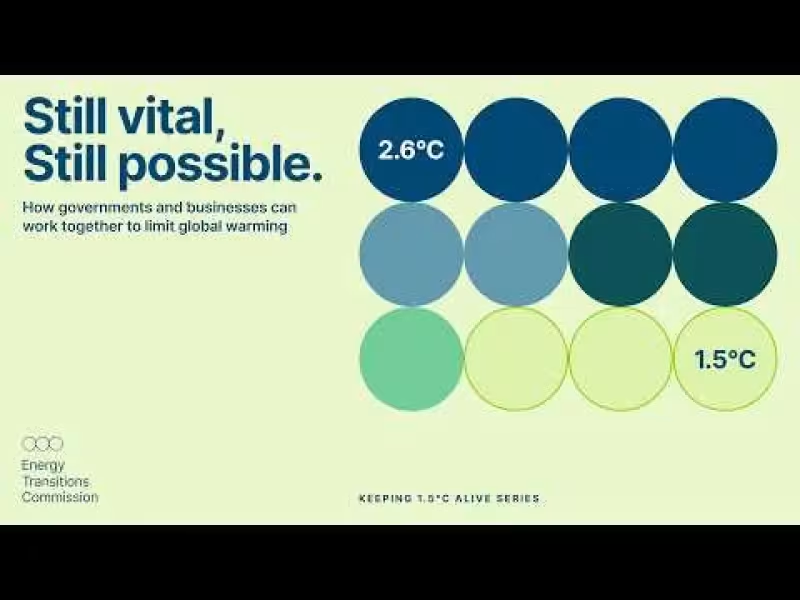
LONDON – November 06, 2026 -- Current policies leave the world on course for 2.6°C of warming by 2100, according to new Energy Transitions Commission (ETC) analysis. More than 30 ETC members have used it to urge COP31 President Murat Kurum and President of Negotiations Chris Bowen to put clean electrification and hard-to-electrify sectors at the centre of the summit outcome.
The letter was published with the ETC briefing "Still vital, still possible" days before negotiators gather in Türkiye. Signatories include ETC Commissioners from Arup, Envision, Grantham Research Institute (LSE), Octopus Energy, Rothschild, Schneider Electric, Tata Steel and Vattenfall, alongside leaders from utilities, heavy industry, transport and finance.
Signatories ask COP31 to back 35% electrification by 2035
The letter sets two priorities. The first is to back a target of 35% electrification by 2035 and to develop country strategies to deliver it. The second is a global commitment to faster decarbonisation of steel, cement, aluminium, chemicals, aviation and shipping, including through carbon prices.
The signatories reject the growing view that the Paris goal of well below 2°C is out of reach. They argue that this narrative could weaken climate policy and corporate commitments just as clean technologies reach scale. In their view, strong commitments could relaunch the policy, investment and cost-decline "ambition loop" that has already cut projected warming from upper bounds of 4°C to 2.6°C.
Clean electrification alone could cut projected warming to 2.3°C
Electricity's share of final energy would rise from 20% to over 50% by 2050, and coal would fall to under 5% of power. The ETC says past forecasts underestimated falling solar and battery costs, so faster electrification could cut bills and emissions. Only early coal retirement carries a clear cost.
ETC Co-Chair Adair Turner said keeping warming well below 2°C is "still vital and still possible", but that some measures will mean accepting higher costs.
Four further levers bring warming to about 1.8°C with policy support
Decarbonising heavy industry, aviation and shipping would remove about 0.2°C but carries a green premium. Green steel costs around 45% more than conventional steel, yet adds only about 1.2% to the price of a car. Carbon prices of around $100 per tonne, close to current EU Emissions Trading System levels, would drive decarbonisation of steel and cement. Aviation and shipping need $200-300 per tonne.
Cutting annual fossil, agricultural and waste methane emissions by around 45% by 2050 removes another 0.2°C. Ending deforestation by 2035 removes a further 0.07°C. Combined with electrification and coal phase-down, the five action areas could bring warming to around 1.8°C, which the ETC says is not cost-free and requires policy support.
Without new policy support, and with technologies adopted only once cost-competitive, warming reaches 2.6°C. ETC Co-Chair Jules Kortenhorst said moving both electrification and the harder sectors would take almost a degree off future warming.
Returning to 1.5°C requires over 500 Gt of carbon removals
Limiting warming to 1.5°C by 2100 requires over 500 Gt of CO2 removals this century, costing over $500 billion a year, or about 0.4% of today's global GDP. Purchased removals currently total less than 20 Mt per year, so the ETC says exponential growth is required.