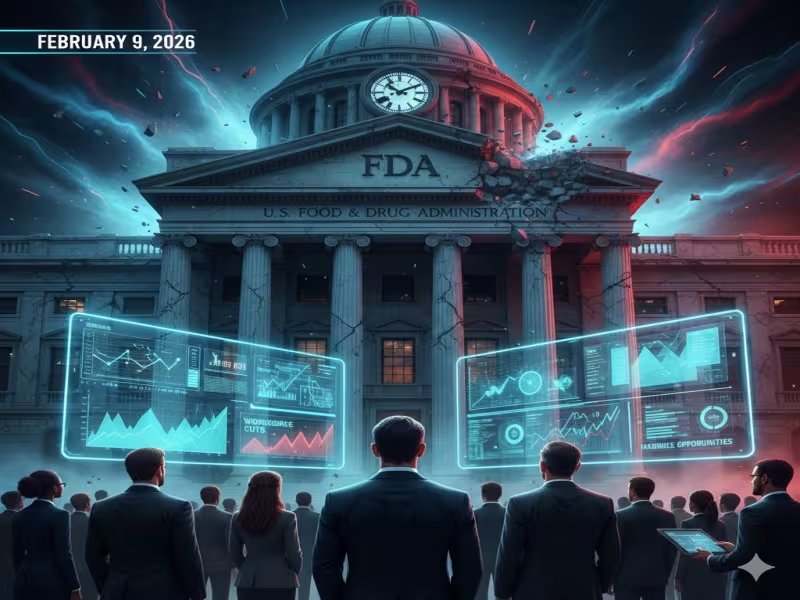
SHERIDAN, WYOMING - February 10, 2026 - The U.S. Food and Drug Administration entered 2026 fundamentally reshaped after a year of unprecedented leadership turnover, shifting regulatory priorities, and workforce reductions under the second Trump administration. Developments throughout 2025 altered both risk profiles and opportunity structures for companies operating in pharmaceuticals, biologics, medical devices, and regulated food markets. For executives and regulatory leaders, understanding how these changes converged is now essential for planning submissions, investments, and compliance strategies in the year ahead.
A Leadership Reset with Structural Consequences
During 2025, the FDA experienced one of the most significant leadership exoduses in its history. Directors of the agency's drug, biologics, veterinary medicine, and tobacco centers departed, alongside numerous deputies and senior program heads. The scale of turnover effectively reset institutional memory and altered internal decision-making dynamics. New appointees have already demonstrated a willingness to reverse or reinterpret prior regulatory approaches, contributing to greater variability in policy signals across product categories.
Political leadership at the FDA and the Department of Health and Human Services has also become more directly involved in product- and class-specific decisions. This has reduced predictability in certain review pathways, while simultaneously opening new avenues for companies prepared to engage early and advocate for alternative regulatory approaches aligned with current priorities.
Selective Deregulation Paired with Targeted Scrutiny
A central feature of 2025 was the administration's push for deregulation, formalized through an executive order requiring agencies to eliminate multiple existing rules for each new regulatory action. Despite concerns about a slowdown in guidance output, the FDA continued issuing new recommendations, often relying on alternative formats such as rapid journal publications to communicate policy shifts.
Several initiatives reduced regulatory burden in defined areas, including steps toward eliminating animal testing in some preclinical studies, removing Risk Evaluation and Mitigation Strategies for certain CAR T cell therapies, and signaling that many biosimilars may no longer require comparative efficacy trials. These changes lowered barriers for select developers but did not apply uniformly across product classes.
At the same time, scrutiny intensified in areas prioritized by HHS leadership. Direct-to-consumer drug advertising emerged as a focal point, with the FDA announcing plans to require full risk disclosure in broadcast and digital ads. Food regulation also tightened, as the agency moved toward mandatory notification for ingredients classified as generally recognized as safe, while states introduced parallel restrictions on food chemicals. The result is a more fragmented compliance environment, particularly for companies operating across multiple jurisdictions.
Acceleration Efforts Amid Workforce Constraints
FDA leadership has emphasized speed and efficiency as core objectives, introducing initiatives intended to offset staffing losses and modernize review processes. Central to this effort is the rollout of generative AI tools designed to support scientific review, alongside pilot programs targeting products that align with administration goals such as onshoring manufacturing, accelerating cures, and reducing drug costs.
New mechanisms, including priority review vouchers, manufacturing-focused programs, and alternative pathways for personalized therapies, offer potential advantages for eligible companies. However, these initiatives coexist with significant staffing reductions, particularly within the drug and biologics centers. Net losses reported for fiscal year 2025 underscore the risk of review bottlenecks, raising questions about whether efficiency gains can fully compensate for reduced human capacity.
Transparency as a Strategic Variable
One of the most consequential shifts for regulated companies has been the FDA's move toward greater transparency. In 2025, the agency began releasing complete response letters shortly after issuance, breaking with longstanding practice. Although often redacted, these disclosures provide more insight into regulatory deficiencies than previously available and increase reputational and market exposure for applicants.
This change places new emphasis on disclosure planning and external communications. Companies must now assume that deficiencies identified during review may quickly enter the public domain, influencing investor sentiment, partner relationships, and competitive positioning. The expansion of transparency initiatives could further broaden the scope of information proactively released by the agency.
Signals to Monitor in 2026
Looking ahead, several indicators will shape regulatory strategy in the coming year. Review performance data, particularly user fee metrics, will offer insight into whether staffing gaps are translating into slower timelines. Ongoing negotiations over user fee programs for drugs, devices, and biosimilars are expected to reveal new priorities, including potential adjustments to fees for foreign manufacturing sites.
The FDA's emphasis on supply chain resiliency is also likely to persist, reinforcing incentives for onshoring while increasing scrutiny of overseas facilities. In parallel, the agency's use of AI tools to monitor promotional activity suggests that surveillance of advertising and digital engagement may expand beyond pharmaceuticals into other regulated product categories.
Strategic Implications for Decision-Makers
The regulatory environment entering 2026 is defined less by uniform policy direction than by selective acceleration, targeted enforcement, and structural change within the FDA itself. For industry leaders, success will depend on early risk assessment, adaptive regulatory planning, and careful alignment with evolving agency priorities. Flexibility, transparency preparedness, and proactive engagement are becoming central capabilities in navigating the FDA's post-2025 landscape.
Learn more about FDA regulatory developments at https://www.fda.gov.