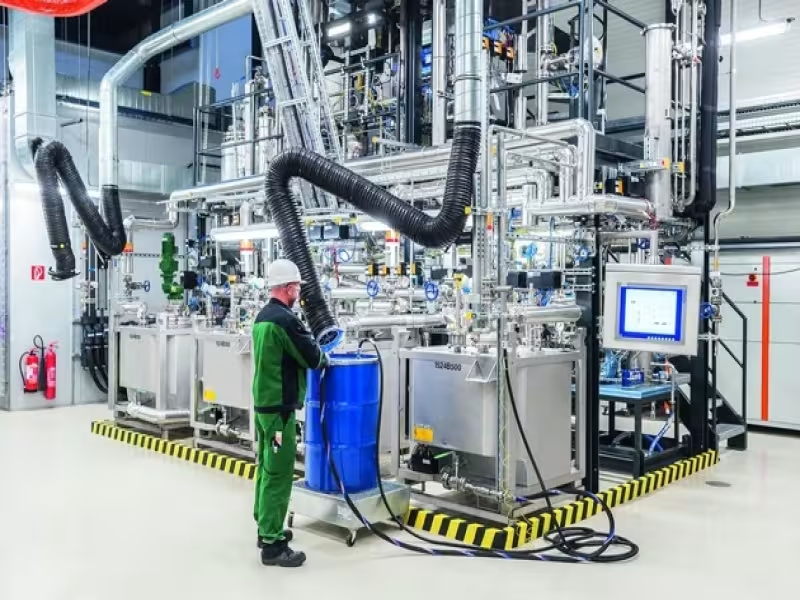
Leuna – November 05, 2026 -- The Fraunhofer Center for Chemical-Biotechnological Processes (CBP) is giving companies access to a multi-purpose pilot plant and to its site infrastructure for customer-owned demonstration plants. Firms can test chemical processes under near-industrial conditions without building a costly facility of their own.
The center targets the gap between laboratory results and industrial production. The gap is widest for processes that use CO2 or renewable resources as feedstock, where suitable test infrastructure is often missing. CBP's Dr. Holger Wondraczek says the core challenge lies less in developing new technologies than in proving they work reliably and economically at industrial scale.
Pilot plants generate data for investment decisions
Pilot and demonstration plants are scaled-down versions of industrial facilities. They test a technology's feasibility, efficiency and marketability, and the resulting data forms the basis for later investment decisions.
If an existing CBP pilot plant fits a customer's process, trials can begin almost immediately, according to Wondraczek. Customer-owned demonstration plants can be built comparatively quickly on the same infrastructure. CBP's operating staff and scientists help identify and reduce scale-up risks early. Wondraczek says this combination is rarely available worldwide.
Pruvia and Mibelle Group projects run on CBP facilities
Pruvia's thermal plastics recycling process was tested at large scale on a plant on CBP's outdoor site. A CBP sister institute is developing a biotechnology process with Mibelle Group to produce palm-oil-free fats from CO2. The process will be piloted on CBP plants ahead of industrial use.
CBP seeks partners to commercialize rapeseed protein process
CBP is also developing its own processes. Its EthaNa process uses the whole rapeseed: press cake becomes an alternative protein source for the food industry, and the rapeseed hulls are put to further use.
The next step is commercialization with potential users. Beyond contract piloting, CBP is seeking talks with industry partners on regulatory requirements and new markets for alternative proteins.