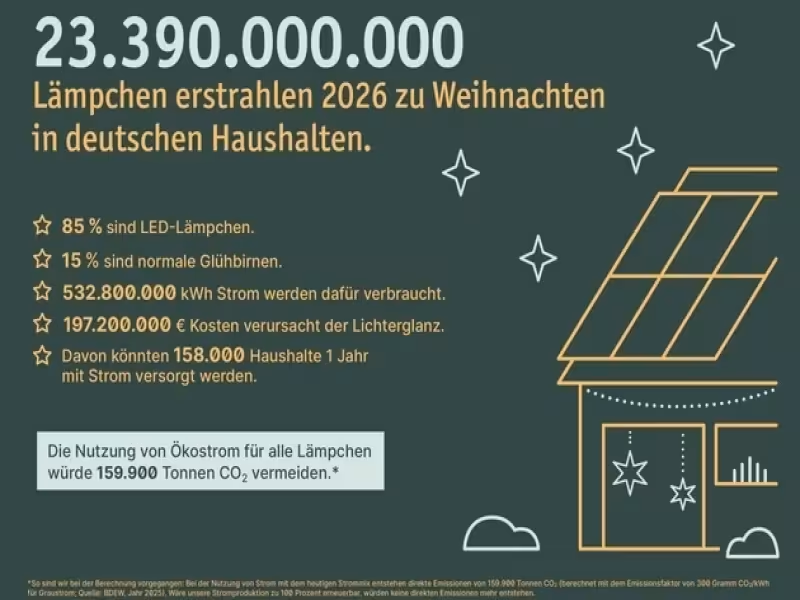
Hamburg – – September 12, 2026 -- German households will illuminate a record 23.39 billion Christmas lights this festive season, pushing national electricity consumption for holiday lighting to roughly 533 million kilowatt-hours, according to the 16th annual LichtBlick Christmas survey conducted by YouGov Deutschland.
Electricity demand for holiday lighting rises 42 million kilowatt-hours year-on-year
The survey, based on 2,103 respondents polled between August 24 and August 25, 2026, found that total power consumption for Christmas lighting climbed from approximately 491 million kilowatt-hours last year to 533 million kilowatt-hours. Powering all lights with green electricity would avoid 159,900 tonnes of CO2, based on a grey-power emissions factor of 300 grams CO2 per kilowatt-hour (BDEW, 2025 data), which currently implies direct emissions of 146,200 tonnes.
LED adoption grows but fails to offset record bulb count
The share of energy-efficient LED lights rose two percentage points to 85 percent compared with the prior year. LichtBlick said this efficiency gain was outweighed by the sheer increase in the number of lights deployed nationwide, driving both total power consumption and CO2 output higher despite the LED gains.
More than half of households switch on lighting daily throughout the season
Over 50 percent of German households run their Christmas lighting every day during the holiday period, both indoors and outdoors. Around one-third keep lights on for three to four hours on operating days, while a quarter run them for five to six hours daily. Only a small minority use their lighting for less than one hour per day.
Public support for municipal Christmas lighting reaches new high of 84 percent
Approval for Christmas lighting in public spaces and on public buildings rose to 84 percent, up from 79 percent in the 2025 survey and marking a new record for the poll series. Only about one in ten respondents considers public holiday lighting unnecessary or a waste of resources.
Ata Mohajer, Communication Manager at LichtBlick, said the record lamp count shows that consumers continue to prioritize festive atmosphere both at home and in public settings such as city centers, squares and buildings.