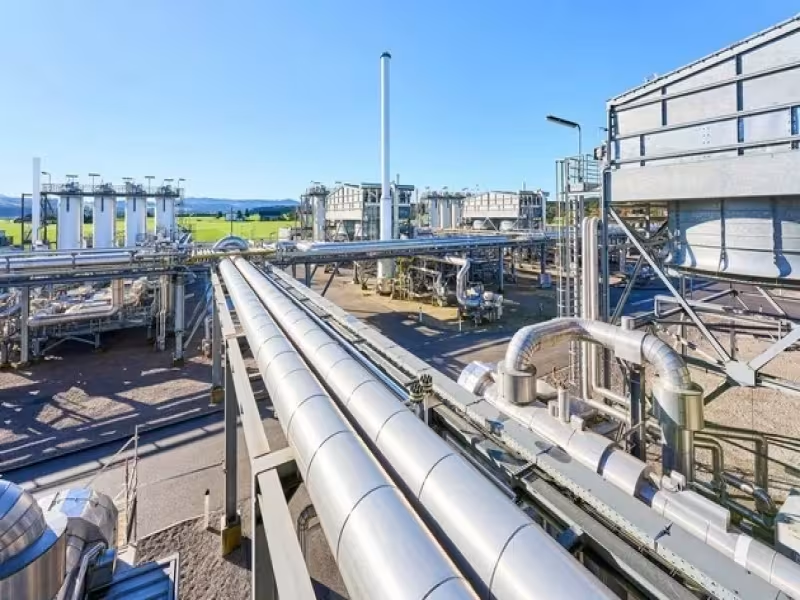
Berlin – September 12, 2026 -- German gas storage levels have fallen to roughly 55%, the lowest level since comparable record-keeping began, according to industry association Die Gas- und Wasserstoffwirtschaft e.V. The trade body insists contractual delivery commitments to customers remain intact despite the record-low reserves heading into winter.
Storage levels alone do not determine supply security, association says
The 55% storage figure has intensified political debate over how Germany will navigate the coming winter. Die Gas- und Wasserstoffwirtschaft argues that supply contracts, storage, pipeline imports and LNG function as an interconnected system rather than storage levels acting as a standalone indicator of security.
Suppliers secure winter volumes through multiple channels, executive states
Dr. Timm Kehler, board member of the association, said customers who have contractually secured their winter gas needs with a reliable supplier can rely on the agreed volumes. An unfavorable summer-winter price spread may make additional storage injections less economically attractive, he said, but this does not cancel existing delivery obligations. Futures markets currently show no expectation of volume shortages by the end of winter, according to Kehler.
Reverse-flow infrastructure investments since 2022 boost network flexibility
Germany's gas network was historically built to transport large volumes of Russian gas from east to west. Following the loss of those supplies, the industry retrofitted technical capacity at numerous points to enable reverse-flow transport, the association said. This allows gas from western and southern import points to be distributed more flexibly across Germany and Europe, broadening access to European storage capacity. The sector has invested in LNG terminals and new import routes since the 2022 energy crisis.
Association urges policymakers to ease storage costs, cut import risks
Kehler called on policymakers to facilitate storage injections and remove regulatory risks for importers. He specifically pointed to the conversion levy — a surcharge for balancing different gas qualities — as an unnecessary cost burden that could be reduced in the short term.
Strategic gas reserve won't be ready until next year, incentives needed
Because the planned strategic gas reserve will not be available until next year, the association said incentives are needed to keep sufficient volumes available for the second half of winter, particularly to guard against late cold spells and to provide flexibility for industrial and commercial customers sourcing gas on short notice.
EU Methane Regulation creates legal uncertainty for long-term import contracts
The association flagged the European Methane Regulation and unresolved implementation questions as sources of continued legal uncertainty for importers, particularly affecting long-term supply relationships that are increasingly important in a global LNG market. It called on the German government and European Commission to establish clear, workable rules and a legally secure transition solution.