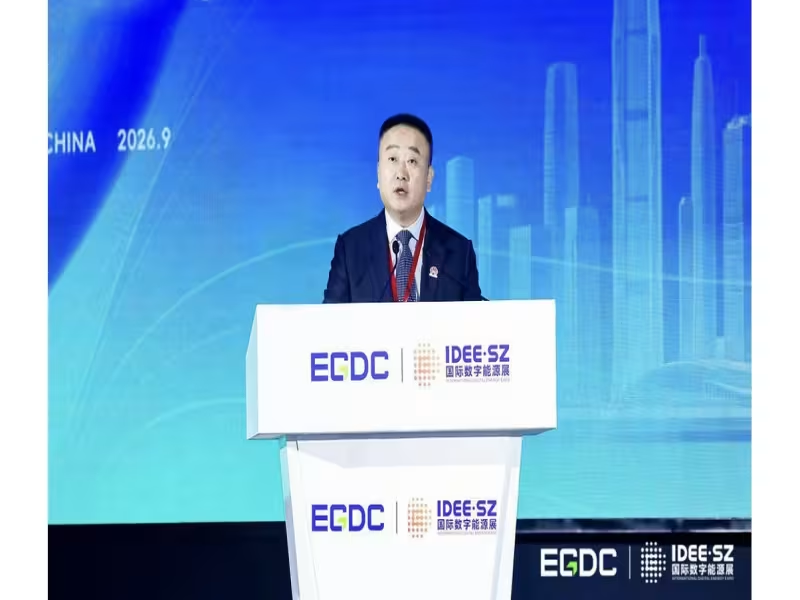
Shenzhen – September 19, 2026 -- Huawei unveiled a grid-interactive AI data center (AIDC) solution at the Green Energy Development Conference & International Digital Energy Expo 2026, targeting power acquisition, high-density cooling, and delivery bottlenecks as AI campuses scale from megawatts to gigawatts.
Huawei's Zhou Jianjun says AIDC load fluctuations now directly impact grid operations
Zhou Jianjun, Vice President of Huawei and President of Global Marketing, Sales and Services at Huawei Digital Power, presented the solution during the conference's key industry achievement release session. He stated that startup, shutdown, and load fluctuations of large AIDC campuses can affect grid operations, and that declining local grid strength combined with rising renewable penetration is forcing data centers to become "grid-friendly" nodes rather than passive consumers.
Huawei structures the solution around a "3+1" framework covering electricity, thermal, digital, and construction
The framework redefines four domains: Watt (electricity), Heat (thermal), Bit (digital), and the construction model. On the electricity side, Huawei's 1000 V grid-forming inverter FusionSolar series and 1000 V Smart String Grid Forming ESS Platform LUTERRA aim to boost renewable grid-forming capability, while an integrated grid-forming energy router based on solid-state transformer technology addresses the load side. Huawei says it became the first vendor to pass the wideband oscillation damping test conducted by Shanghai Electrical Apparatus Research Institute.
Thermal and digital redesign target system-wide reliability over component-level fixes
For thermal management, Huawei's Thermal Management Unit and AI-enabled MW-level liquid cooling system are positioned to extend reliability from individual components to the full chip-to-cooling-source chain. On the digital front, AI capabilities are applied to shift AIDC operations from passive maintenance to proactive sensing and protection.
Huawei shifts construction complexity to factory-based prefabrication to speed compute rollout
Huawei is moving away from traditional on-site engineering toward productized, prefabricated, and modularized construction, aiming to compress deployment timelines for compute capacity.
Zhou said Huawei integrates digital technology, power electronics, thermal management, and energy storage management to build capabilities across renewable generation, grid forming and connection, high-density compute power supply, liquid cooling, and compute-electricity synergy, adding that the company aims to work with global customers and partners to advance AIDC industry development.