Shanghai – – September 20, 2026 -- Huawei unveiled a grid-interactive AI data center (AIDC) solution at HUAWEI CONNECT 2026, targeting maximum tokens-per-watt output as AI workloads strain power grids worldwide.
Huawei ties compute and energy infrastructure directly to grid stability
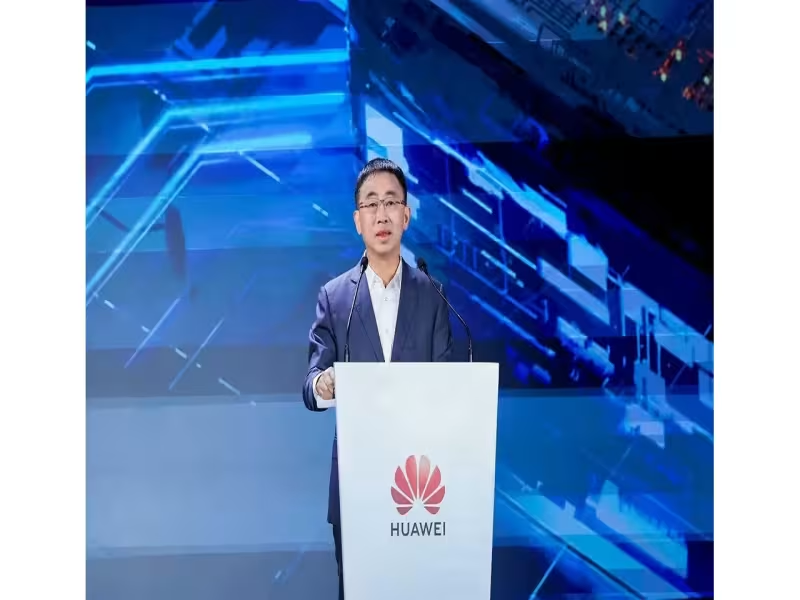
Hou Jinlong, Director of the Board of Huawei and President of Huawei Digital Power, opened the AIDC Facility Summit by outlining four design priorities: power acquisition, power quality, rack-level power and cooling, and faster engineering delivery. He stated that maximizing tokens per watt and minimizing cost per token will define the competitiveness of future compute factories.
New "3+1" architecture combines liquid cooling with hybrid energy storage
Bob He, Vice President of Huawei Digital Power, said rising renewable energy penetration is making power grids more electronically volatile, while AI workloads generate rapid, severe power fluctuations. Huawei's response, the grid-interactive AIDC 1.0 solution, integrates grid-friendly UPS units, intelligent lithium batteries, and grid-forming energy storage systems to let data centers absorb load swings while supporting grid stability. A companion AI-powered liquid cooling system predicts the health of cooling fluids to enable predictive maintenance.
In the power domain, Huawei introduced a MIMO (multiple-input, multiple-output) power supply architecture designed for future AIDC deployments. He said Huawei's differentiation rests on combining end-to-end energy engineering with full-stack AI capabilities.
SenseTime reports an 80% efficiency gain using a new tokens-per-watt metric
Lin Hai, General Manager of the Intelligent Computing Center within SenseTime's SenseCore Business Group, said the industry is shifting from power usage effectiveness (PUE) to tokens per watt (TPW) as the primary efficiency benchmark. TPW links electricity consumption directly to token output across the full chain, from power plants and grids to IDC racks, cloud computing services, and model services. Through end-to-end optimization under this framework, SenseCore has improved its TPW by 80%.
Industry leaders call for redesigned power architecture at gigawatt scale
Xia Qin, Chief Expert in Huawei's Computing Strategy Planning unit, said AIDC infrastructure is converging into an integrated compute-network-storage architecture in which reliable, efficient, and rapidly deployable energy systems are foundational to large-scale AI training and inference.
Josh Chen, Founder and Chairman of VNET Group, said traditional data centers have limited grid interaction, leaving them exposed to high-frequency load swings that can trigger grid disconnection or unstable wideband oscillation. He proposed redefining power sources, campuses, and buildings to enable mutual support, campus-level scheduling, and direct-current power supply for buildings, forming a new power system built around direct green power connections and active microgrids to serve gigawatt-scale AIDCs reliably.
Huawei also showcased a one-stop AI inference solution at the event alongside the grid-interactive AIDC platform.