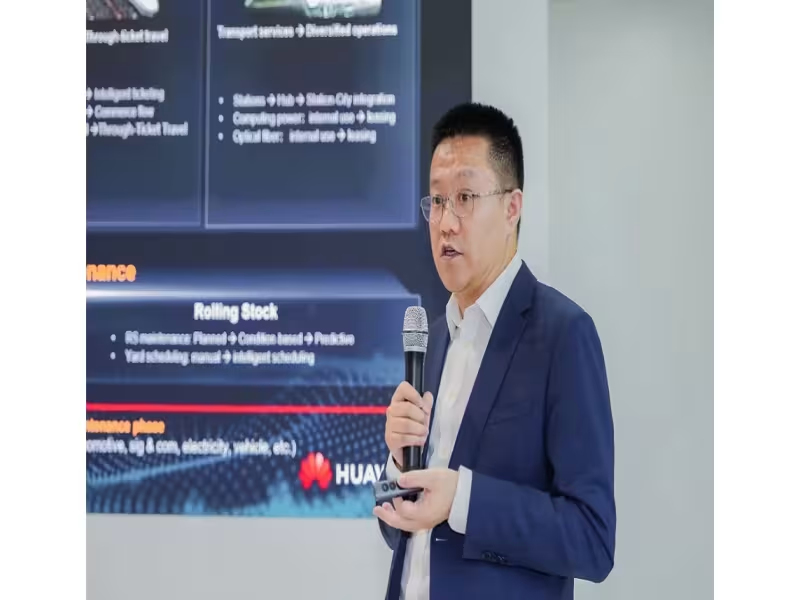
Berlin – September 29, 2026 -- Huawei has launched Intelligent RAIL 2.0, a portfolio of 20 scenario-based solutions targeting railway construction, passenger and freight transport, and facility maintenance, unveiled at InnoTrans 2026 held September 22-25 in Berlin.
Huawei has already deployed rail technology across 180,000 kilometers of track worldwide
The company says it now serves more than 50 major railway customers and over 300 urban rail lines globally, positioning the new platform as an expansion of an existing large-scale deployment base rather than a market entry.
Industry bodies UIC and UITP joined the launch to back AI standardization in rail systems
Jean-Michel Evanghelou, Director of Digital Systems & Innovation at the International Union of Railways (UIC), said the FRMCS communication standard marks the first step toward a digital foundation for rail operators, adding that standardization of AI applications will become increasingly critical as such tools integrate deeper into core rail systems. UITP Secretary-General Mohamed Mezghani and Lidia Signor, the association's Head of Multimodal Transport, also attended. Signor referenced a joint UITP-China Association of Metro (CAMET) report, "AI-Driven Smart Rail Transport," documenting AI deployment across metro construction, operations and maintenance to improve efficiency and safety.
Huawei frames the strategy around four capability pillars for next-generation rail infrastructure
Raymond Zuo, President of Huawei's Smart Rail Business Unit, outlined an "intelligent RAIL" innovation strategy built on reliability, automation, integrated services and long-term technology evolution. He pointed to sector-wide shifts: communication infrastructure moving from GSM-R to FRMCS, maintenance shifting toward condition-based and predictive models, freight moving toward end-to-end multimodal logistics, and passenger services trending toward seamless travel experiences.
The 20 solutions are co-developed with partners under a modular design model
Huawei said the scenario-based solutions were jointly built with ecosystem partners, with Huawei supplying communication and digital platform infrastructure while partners contribute industry-specific applications. The modular, combinable structure is intended to let rail operators tailor deployments to individual business scenarios rather than adopting a single fixed system.
Huawei said it will continue its "platform + ecosystem" approach, working with global customers and partners to track technology trends and integrate emerging capabilities into rail operations.