AI Infrastructure & Data Centers

Cisco, NVIDIA Plan Open 400G Optics as P200 Hits Production

Image
Cisco, NVIDIA Plan Open 400G Optics as P200 Hits Production

San Jose – October 13, 2026 -- Cisco and NVIDIA plan to develop an open industry specification for a 400Gb/s-per-lane pluggable optical module that is expected to deliver 4x the bandwidth density of 200Gb/s-per-lane optics. The companies announced the Ultra-Dense Small Form Factor Pluggable (USFP) at the Open Compute Project (OCP) Global Summit 2026.

Cisco also said the first systems powered by its 102.4T Silicon One G300 are shipping to customers. Its 51.2T P200-based systems are running in production at hyperscalers, including Microsoft and Alibaba.

USFP targets 4x bandwidth density and 1.3x power efficiency

Cisco and NVIDIA said USFP is expected to deliver 1.3x the power efficiency of 200Gb/s-per-lane optics. They say it relies on a proven operating model to reach 400Gb/s per lane, and that it preserves serviceability, deployment flexibility and the operational simplicity of today's pluggable optics.

Flex Launches AI Modules to Cut AI Factory Build Time by 50%

Image
Flex Launches AI Modules to Cut AI Factory Build Time by 50%

San Jose – October 13, 2026 -- Flex (NASDAQ: FLEX) has introduced prefabricated AI Modules that integrate power, compute and liquid cooling, and it says they cut AI factory deployment timelines by up to 50% compared with traditional construction.

The modules are part of Flex's Cloud and Power Infrastructure (CPI) segment. Flex plans to separate that segment into Axiom Solutions International, Inc. (Axiom), an independent publicly traded company, in the first quarter of calendar 2027.

Axiom AI Modules combine three factory-built systems

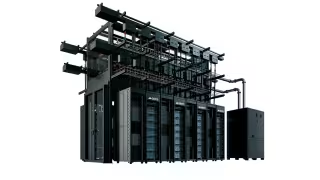
The pre-engineered modules include an 800 VDC power rack for power conversion and distribution, advanced cooling distribution units (CDUs) for liquid cooling, and high-density IT racks. The IT racks integrate AI servers, networking and high-speed interconnects.

ASRock Rack Shows NVIDIA Vera Rubin AI Servers at OCP Summit

Taipei – October 13, 2026 -- ASRock Rack Inc. is displaying a Vera Rubin NVL72 rack platform, which it says will be available for deployment in the near future, at booth D37 of the 2026 OCP Global Summit in San Jose, California. The event runs October 12 to 15.

ASRock Rack pairs NVIDIA Vera CPUs and HGX Rubin NVL8 with liquid cooling

The 2UXGM-VERA2 carries two NVIDIA Vera CPUs. ASRock Rack built it for agentic AI workloads, citing complex data pipelines and multi-step reasoning.

The 2U16X-GNR2/DLC Rubin is fully liquid-cooled and uses the NVIDIA HGX Rubin NVL8 platform. The company says it provides unified compute and memory bandwidth for massive-scale reasoning models.

The 6UXGM-GNR2 CX8/DLC is based on NVIDIA MGX architecture. It supports liquid-cooled NVIDIA RTX PRO 6000 Blackwell Server Edition GPUs for enterprise AI, visual computing and inference deployments.

HARTING Joins NVIDIA MGX With 800 VDC Power Whips for Vera Rubin

Image
HARTING Joins NVIDIA MGX With 800 VDC Power Whips for Vera Rubin

Espelkamp – October 13, 2026 -- HARTING Technology Group has joined the NVIDIA MGX ecosystem as a power system component provider for the NVIDIA Vera Rubin NVL72 platform, supplying power whips that span the shift from 480 VAC to 800 VDC data center architecture.

HARTING supplies two power whips covering both MGX power generations

Power whips are cable assemblies that distribute power from the building to each rack. For the 3RU 110kW power shelf of the Vera Rubin NVL72, HARTING provides a 100A/480VAC power whip. For the move to 800 VDC, it offers a next-generation 157A/800 VDC DC-DC power whip that connects the power infrastructure to the compute rack.

Rising compute density forces data centers to handle significantly more power in tighter spaces while maintaining reliability, efficiency and scalability. That puts new demands on the connectivity systems that feed AI infrastructure.

SWI Group Raises €800M at €6.1B Valuation for AI Compute Push

Image
SWI Group Raises €800M at €6.1B Valuation for AI Compute Push

Amsterdam – October 12, 2026 -- Euronext Amsterdam-listed SWI Group (SWICH) has raised €800 million from institutional investors at a final valuation of €6.1 billion, lifting total equity raised since March 2026 to more than €1 billion.

New share series lift capital base to 558,399,385 ordinary shares

SWICH is issuing the new ordinary shares in several series. The total share capital rises to 558,399,385 ordinary shares after the transaction.

Proceeds fund data center and AI compute build-out in Europe and the US

The company will use the proceeds to develop and scale its data center and AI compute capacity. Spending covers power infrastructure, compute deployments and its development pipeline on both sides of the Atlantic. SWI describes the raise as a step in consolidating its transatlantic digital infrastructure and AI compute platform.

CIQ's RLC Pro AI Adds Kernel 6.18, 10-Minute Local AI Stack

Image
CIQ's RLC Pro AI Adds Kernel 6.18, 10-Minute Local AI Stack

Global – October 12, 2026 -- CIQ's latest RLC Pro AI release lets a developer stand up a working local AI stack in about 10 minutes and adds CIQ Linux Kernel 6.18 for large production environments, according to Brian Dawson, the company's Director of Product Management.

CIQ targets the operating system as the overlooked layer of AI stacks

Dawson argues that organizations pour capital into GPUs, models, frameworks and applications while treating the operating system as an afterthought. "We've moved so fast with AI that the OS has become the forgotten layer," he said.

CIQ: Linux 6.18 Loads AI Model Weights 33.8% Faster

Image
CIQ: Linux 6.18 Loads AI Model Weights 33.8% Faster

Santa Clara – October 12, 2026 -- CIQ says model loading ran 33.8 percent faster on Linux 6.18 than on a kernel frozen at general availability, based on its own benchmarks of the same workload. The company is pitching the result for RLC Pro AI, its Enterprise Linux distribution for GPU infrastructure.

CIQ's argument is that AI hardware and frameworks move faster than the operating system beneath them. NVIDIA advances the hardware, CUDA the toolkit and PyTorch the framework. An enterprise kernel, by design, trails by an average of twelve to eighteen months. RLC Pro AI ships Linux 6.18, the latest production and long-term GPU drivers, and the CUDA toolkit together, validated as one stack.

CIQ's RLC Pro AI Image Cuts Sovereign AI Setup to Three Steps

Image
CIQ's RLC Pro AI Image Cuts Sovereign AI Setup to Three Steps

Global – October 12, 2026 -- RLC Pro AI (Rocky Linux from CIQ) now ships as a container image bundling GPU drivers, system dependencies and inference backend software, reducing a sovereign AI deployment to three steps, according to guest author Zach Deane-Mayer of AI Insight Solutions.

The pitch targets dependence on frontier AI labs. Those labs sell turnkey AI priced by the token, set the deprecation schedule and can revoke customer access at any time. Deane-Mayer argues that businesses reliant on AI should own the stack it runs on.

Fuzzball v4.3 Ships 11 Preset LLMs for Self-Hosted GPU Serving

Image
Fuzzball v4.3 Ships 11 Preset LLMs for Self-Hosted GPU Serving

Global – – October 12, 2026 -- Fuzzball v4.3 adds a vLLM catalog entry and eleven validated model presets that serve a large language model from a pool of replicas on NVIDIA or AMD GPUs, behind an OpenAI-compatible endpoint.

Eleven presets come with GPU count, context size and vLLM arguments already set

The generic vLLM entry serves a HuggingFace model from a single catalog command. The eleven presets cover GPT-OSS 20B and 120B, Ministral 3 8B and 14B, Qwen3-Coder 30B and Next 80B, Nemotron 3 Nano and Super, Mistral Medium 3.5, Llama 4 Scout and Gemma 4 31B. Each has its GPU fit and serving arguments validated per model.

Users can accept the preset values or override them. In one example, a persistent volume keeps the downloaded checkpoint between starts, and MaxReplicas is raised to eight so the pool can grow under load.

CIQ Fuzzball 4.3 Launches Private LLM Inference in a Few Clicks

Image
CIQ Fuzzball 4.3 Launches Private LLM Inference in a Few Clicks

United States – October 12, 2026 -- CIQ's Fuzzball 4.3 lets users launch large language models for inference in a few clicks, drawing on a catalog of nearly a dozen preconfigured LLMs that can run on an organization's own HPC cluster or in the cloud.

Fuzzball 4.3 removes manual setup for LLM serving

Users pick a model from the workflow catalog and interact with it through a browser or command line client. Fuzzball scales model services up or down with demand and provides a durable endpoint for access.

Earlier versions required more work for any model missing from the catalog. Users had to write a Fuzzfile, determine the model's compute requirements, sometimes by trial and error, and find a way to reach an autoscaled node pool without a single endpoint. Version 4.3 removes most of those steps.