IT, AI & Telecommunications

BCE Sells 49.9% of Bell Tower Unit to La Caisse for CAD 2.45B

MONTREAL – October 29, 2026 -- BCE Inc. said its subsidiary Bell Canada will sell a 49.9% stake in a newly formed wireless tower company to investment group La Caisse for CAD 2.45 billion, subject to customary adjustments. The price values the business at about CAD 4.91 billion.

TowerCo takes over 5,000-plus Bell sites

The new entity, TowerCo, will own and operate Bell's portfolio of passive wireless infrastructure. BCE describes it as Canada's largest dedicated tower company, with more than 5,000 sites nationwide. It will be headquartered in Montreal and led by CEO J. Bruce Furlong.

TowerCo plans to grow through new site builds, site densification and third-party colocation, which lets other service providers use its towers.


Edge AI Moves Onto Cellular IoT Modules, Cutting Cloud Dependence

Image
Edge AI Moves Onto Cellular IoT Modules, Cutting Cloud Dependence

Global – October 29, 2026 -- Small language models under 10 billion parameters are starting to run on GPU/NPU-powered edge hardware with as little as 4GB of RAM, but most deployed IoT devices still depend on the lightweight compute inside the cellular modem SoC, according to Telit Cinterion.

Cellular modules host inference on the same chip that manages the network

Edge AI runs the model on the device itself. The device responds with near-zero latency, consumes far less bandwidth and keeps working if the network connection drops. Cloud-dependent products send a sensor value to a server and wait for the result, which adds latency and network dependence.

In many IoT products, the cellular module is the edge. The chip that handles the radio and network connection can also run a small model. Because the module reads its own signal quality, a model can monitor network availability and optimize reliability dynamically.

Three CVSS 9.2 Pillow Flaws Enable Code Execution via Image Upload

Image
Three CVSS 9.2 Pillow Flaws Enable Code Execution via Image Upload

Global – October 29, 2026 -- Three critical vulnerabilities rated CVSS 9.2 in Pillow, the Python imaging library with an estimated 436 million monthly downloads, let a single crafted EPS, TIFF or JPEG file trigger command execution or heap corruption in any Python service that processes user-supplied images. Disclosed on 2026-10-19, all three flaws are fixed in Pillow 13.0.0.

Pillow is a maintained fork of the original Python Imaging Library. Web frameworks such as Django and Flask, thumbnail and avatar pipelines, document and PDF tooling, and most Python machine-learning and computer-vision stacks pull it in directly or transitively. Because it routinely parses untrusted image bytes, the bugs are reachable through a plain file upload.

99.3% of Exposed PHP Hosts Unpatched 24 Hours After PHP2Shell Fix

Image
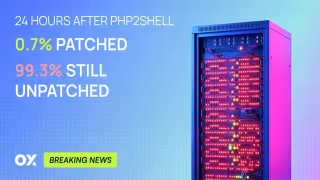
99.3% of Exposed PHP Hosts Unpatched 24 Hours After PHP2Shell Fix

GLOBAL – October 29, 2026 -- Only 14,151 of 1,974,890 measurable PHP instances in the affected version range showed a patched release 24 hours after PHP shipped emergency fixes for the PHP2Shell flaws, leaving 99.3% exposed, according to OX Security.

PHP released the fixes on October 21 for CVE-2026-109618 and CVE-2026-109619. Both are critical vulnerabilities that allow unauthenticated remote code execution in the PHP engine itself. Governments and security agencies urged organizations to patch immediately, and some organizations took systems offline.

93.6% of PHP Hosts Still Exposed to PHP2Shell Five Days After Fix

Image
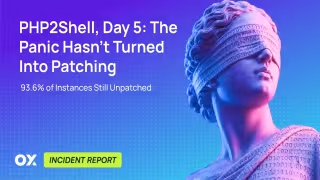
93.6% of PHP Hosts Still Exposed to PHP2Shell Five Days After Fix

Global – October 29, 2026 -- Five days after the PHP project shipped emergency fixes for the PHP2Shell flaws, 93.6% of measurable PHP instances remain exposed, according to OX Security scans run through October 26, 2026. That is roughly 15 of every 16 hosts the firm can measure.

The PHP project released the fixes on October 21 for CVE-2026-109618 and CVE-2026-109619. Together, the two critical flaws let an unauthenticated attacker execute code remotely inside the PHP engine. Security agencies issued urgent advisories, and some organizations took systems offline while assessing their exposure.

NVIDIA Launches Kumo Graph AI Models Inside Snowflake ML

Image
NVIDIA Launches Kumo Graph AI Models Inside Snowflake ML

Global – October 29, 2026 -- NVIDIA has released Kumo, a family of open models, libraries and tools for predictive AI on structured data, and Snowflake customers can run it on GPU compute without moving data out of their accounts. The release is part of NVIDIA's new Agent Knowledge Foundation, a set of open models and libraries meant to help enterprise agents retrieve evidence, apply consistent business meaning, predict outcomes and optimize actions.

Kumo trains graph neural networks on full relational structure

The NVIDIA Kumo Relational model and NVIDIA Kumo Engine, an open-source package, train graph neural networks across an enterprise's relational graph. Kumo learns from tables, the keys connecting them and the timing of events. Teams do not need to flatten these links into a single wide table.

Reconnected OPC UA Links Can Still Leave Historian Data Gaps

Image
Reconnected OPC UA Links Can Still Leave Historian Data Gaps

Global – October 29, 2026 -- A restored OPC UA connection does not guarantee that the historian holds every value generated during an outage, because the three links in the data path (source, collector and historian) each lose data in different ways. Buffering at one layer cannot repair a loss that occurred earlier in the chain.

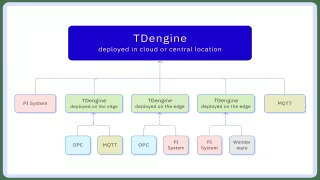
In the common architecture of device or PLC, OPC UA server, collector and historian, the first step is to find which link failed. If the device or server stops producing values, the collector has nothing to recover unless the source keeps its own history. If the collector cannot reach the historian, a durable local buffer can protect messages it has already collected. Treating all three as a generic network outage leads to the wrong fix.

Windward Tracks Vessels Loitering Over Subsea Cables in Five Theaters

Image
Windward Tracks Vessels Loitering Over Subsea Cables in Five Theaters

Guam – October 29, 2026 -- Windward data shows vessels linked to China and Russia loitering over subsea cable and pipeline corridors in five theaters. Activity ranges from the Guam cable hub to the Luzon Strait, Bab el-Mandeb and the gas pipelines feeding St Fergus, which supplies 25 to 50% of Britain's gas.

Chinese survey grids cover the Guam and Japan cable corridors

A Chinese-flagged fishery patrol vessel run by a state fishery research institute has worked research-pattern grids on both sides of Guam for seven weeks. Guam is the landing point for 11 subsea cables. The vessel ran a grid east of Guam between the Bulikula and SEA-US cables from August 31 to around September 20. A second grid west of Guam in the Philippine Sea was still running on September 29.

Pacific Cable Risk Hinges on Vessel Behavior, Windward Data Shows

Image
Pacific Cable Risk Hinges on Vessel Behavior, Windward Data Shows

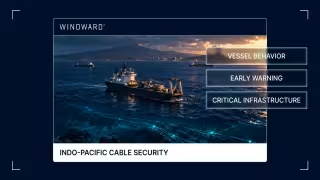
Honolulu – October 29, 2026 -- Windward recorded 27 slow-speed service and research vessel events near cable routes around Hawaii and 5 around Guam and the Northern Marianas in Q1 2026, as concentrated landing sites and a thin repair fleet leave Indo-Pacific cable security dependent on early warning.

Hawaii and Guam concentrate trans-Pacific cable exposure

Both islands anchor the trans-Pacific links connecting the continental U.S. to forces, allies and partners in the theater. A September 2026 report for the U.S.-China Economic and Security Review Commission (USCC) found that the continental U.S. connections to Hawaii and Guam are particularly vulnerable to gray-zone sabotage, with few redundancy options.

Iran Threatens Hormuz Cables as Four Gulf States Lack Bypass

Image
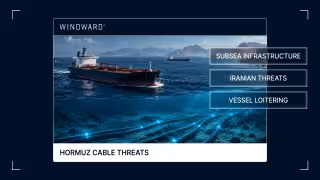
Iran Threatens Hormuz Cables as Four Gulf States Lack Bypass

Tehran – October 29, 2026 -- Iraq, Kuwait, Bahrain and Qatar have no subsea route to the outside world that avoids the Strait of Hormuz, after an Iranian Revolutionary Guard Corps (IRGC) spokesman said on October 19 that seven major internet cables run beneath the waterway and that new targets and weapons would be unveiled.

Spokesman Hossein Mohebbi told a ceremony in Tehran that the response this time would be much harsher. Earlier in October, Supreme National Security Council secretary Mohsen Rezaei said Iran could strike U.S.-linked cables, data centers and AI facilities in a new war. In May, the IRGC said every cable crossing the strait could be placed under Iranian permits.