Kawanishi – September 28, 2026 -- Green Science Alliance has more than doubled the performance of its aqueous rechargeable aluminum-ion battery (AAIB) by swapping the cathode current collector for a commercially cheap conductive carbon rubber sheet, according to research led by Dr. Ryohei Mori.
Capacity climbs to 210 mAhg-1 from an earlier 103 mAhg-1 baseline
Under 0.025 C at room temperature, the redesigned AAIB delivered an initial capacity of at least 210 mAhg-1, sustained through at least 25 cycles in ongoing testing. The prior generation of the technology, detailed in Mori's 2025 review article in the Royal Society of Chemistry journal Energy Advances (DOI: 10.1039/D5YA00148J), had capacity of roughly 103 mAhg-1 with poor cycle stability.
Carbon rubber sheet replaces costly corrosion-resistant metals
The porous rubber sheet allows the graphite cathode active material to penetrate its structure, forming a 3D composite that maintains conductive pathways while letting aqueous electrolyte reach a larger surface area for reaction. Mori found that a dense carbon board substitute failed to reproduce this performance, pointing to porosity as the key mechanism. Critically, the rubber sheet eliminates the need for expensive corrosion-resistant metals such as molybdenum, niobium or tantalum, which conventional ionic-liquid-based aluminum batteries require for their cathode current collectors.
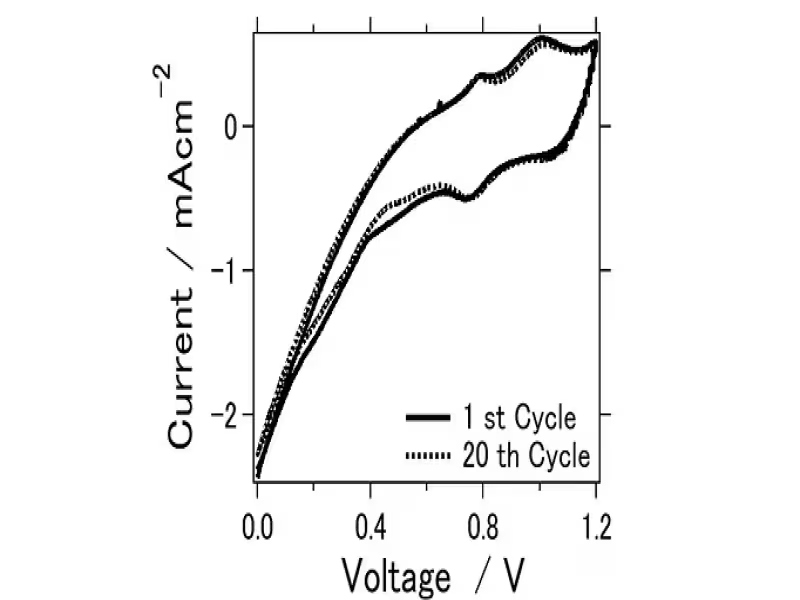
Redox peaks persist after 100 cycles, confirming rechargeable operation
Cyclic voltammetry conducted below the 1.23 V theoretical water-splitting threshold showed redox peaks still present after 100 cycles, confirming ongoing charge-discharge activity. Cell voltage measured 0.9-1.0 V, lower than typical lithium-ion cells, though Mori notes this gap can be addressed through series connections.
Cost target could undercut $55-60 per kWh Al-ion benchmark
The battery uses graphite as cathode active material, ordinary paper as a separator, and a high-concentration aqueous aluminum perchlorate hexahydrate electrolyte, alongside a specially formulated but low-cost aluminum anode. Lithium-ion battery costs run near $115 per kWh, while aluminum-ion batteries using ionic liquid electrolytes are projected to reach $55-60 per kWh at scale. Because AAIBs avoid both inert-atmosphere manufacturing and corrosion-resistant metal collectors, Mori expects production costs to fall below that $55 per kWh range.
Findings head to Calgary for October electrochemical society meeting
Part of the results will be presented at the 250th ECS (The Electrochemical Society) Meeting in Calgary, Canada, in October 2026. Mori said work continues to further improve capacity and cycle stability toward industrial-scale deployment.