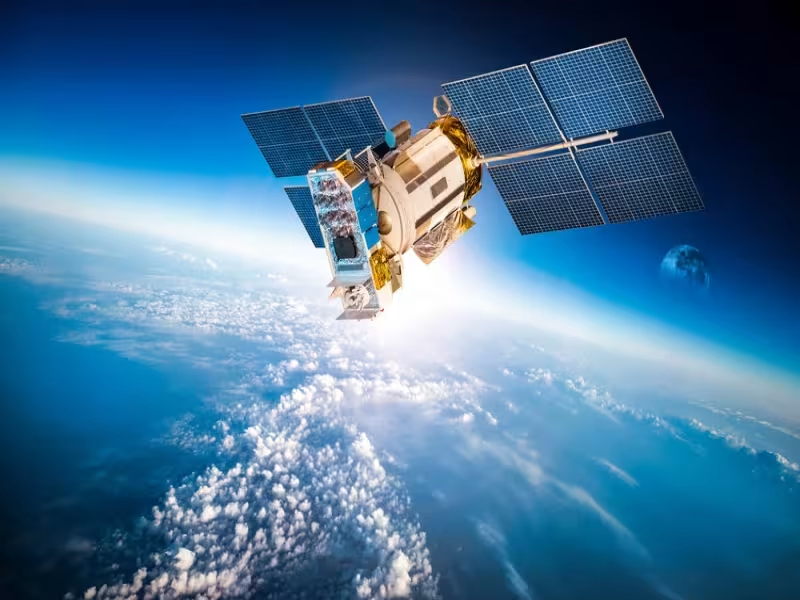
RUSSIA -- November 26, 2026 -- Reports on November 23 said Russia plans to launch a nuclear-armed satellite named Sputnik-S "at any time in the coming weeks" after storing the alleged weapon in the Moscow region for years. The Kremlin swiftly denied the claim.
The report does not identify the original source of the claim or provide evidence. Tomas Nagy, a senior research fellow at the Slovakia-based think tank GLOBSEC, told RFE/RL that evidence Russia has developed a space-capable nuclear weapon remains patchy.
Experts say a high-altitude blast would hit satellites of every nationality
Nagy says such a weapon, if it exists, could disable a swath of satellites, including the Starlink constellation. It would not necessarily destroy every spacecraft, he says, but the effect would be indiscriminate: Western, Russian, Chinese and other satellites could all be affected.
The main damage comes from the electromagnetic pulse (EMP), which travels at the speed of light and disables electrical systems in its path. Subsequent radiation can further degrade satellite components.
Victoria Samson, chief director of space security and stability at the US nonprofit Secure World Foundation, says satellites within line of sight of a blast would be damaged or disabled in large numbers. Most are not hardened against nuclear radiation, she says, so Starlink service "would probably not be an option."
Ukraine relies heavily on the US Starlink system for battlefield coordination in Russia's ongoing full-scale invasion. That makes Ukrainian military communications a direct exposure in any such scenario.
The 1962 tests damaged satellites and power grids far from the blasts
The US detonated Starfish Prime, a 1.4-megaton thermonuclear warhead, on July 9, 1962, about 400 kilometers above the Pacific Ocean. Honolulu and the rest of Hawaii, more than 1,200 kilometers away, lost streetlights, and hundreds of burglar alarms went off. By our calculation, the damage reached at least three times the height of the burst.
Several of the dozens of satellites then in orbit were damaged or disabled, including the UK's first satellite, Ariel 1.
Months later, a Soviet high-altitude test over Kazakhstan, which the source says was about 20 times as powerful as the Hiroshima bomb, burned out power lines and started a fire in a power station. It also disabled a buried power cable linking two cities. Many effects of the Soviet tests have never been disclosed.
The Partial Nuclear Test Ban treaty, ratified in 1963 by the US, UK and USSR, prohibited nuclear detonations in space. A later treaty banned placing nuclear weapons in orbit. The 1962 tests are 64 years old, and Samson says today's greater number of satellites, built with more electronics, would suffer more in low Earth orbit.
A 2010 report put damage estimates at one to two orders of magnitude of uncertainty
A 2010 report on EMP damage to satellites concluded that "uncertainties as large as one to two orders of magnitude are postulated," owing to a lack of modern data. Palmer Luckey, an American weapons manufacturer, told a New York summit that the US should resume nuclear testing largely to study EMP effects on modern infrastructure. "We don't actually know what will happen to our phones, to our critical infrastructure, to our military," he said.