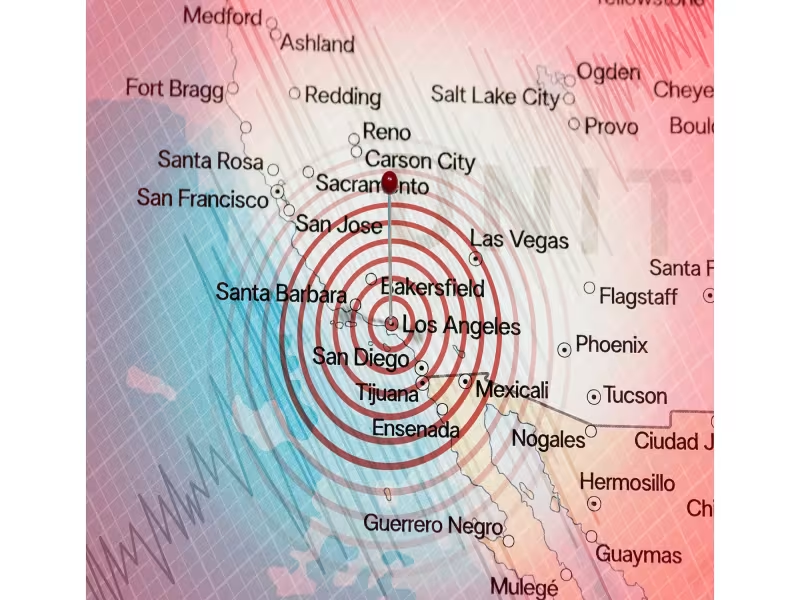
Los Angeles – September 28, 2026 -- Fewer than 15% of Los Angeles properties covered by the city's mandatory non-ductile concrete retrofit program had submitted retrofit plans more than a decade after the ordinance took effect, according to research published in Earthquake Spectra in July 2026.
Colombia's $13.28 Billion Earthquake Loss Underscores Retrofit Stakes
A magnitude 7.4 earthquake struck western Colombia in August 2026, damaging more than 225,000 structures and causing an estimated $13.28 billion in direct physical damage, according to a United Nations Development Programme assessment. The scale of destruction has renewed scrutiny of Los Angeles buildings that share similar structural vulnerabilities.
Financing Remains the Top Barrier to Compliance
Researchers cited financing as the greatest obstacle to retrofit compliance in Los Angeles, alongside technical, relocation, and governance challenges. Kyle Tourjé, Executive Vice President of Alpha Structural, said reinforcing steel volume alone does not determine earthquake performance. "A building can contain significant amounts of reinforcing steel and still perform poorly," Tourjé said.
Los Angeles Ordinance Targets Buildings Permitted Before January 1977
The city's retrofit program applies to certain concrete buildings for which permit applications were submitted before January 13, 1977 -- a cutoff tied to major seismic-code changes affecting how reinforced concrete was detailed. Tourjé said deficiencies commonly found in older structures include insufficient lap-splice lengths, wide tie and stirrup spacing in columns and beams, and inadequate confinement at beam-column joints. "Site investigations, material testing, reinforcement mapping, and selective exploratory work may be needed to understand the structure that is actually there today," he said.
Retrofit Scope Can Span Multiple Structural Systems
Unlike soft-story retrofits that target a single vulnerable level, non-ductile concrete retrofits may require engineers to evaluate how columns, beams, diaphragms, and connections behave together. Strengthening options can include new shear walls, steel bracing, and steel or concrete moment frames. Tourjé said some projects allow phased improvements based on deficiency severity, occupancy constraints, and available financing, with the Los Angeles Department of Building and Safety pointing owners toward Property Assessed Clean Energy (PACE) financing for eligible seismic upgrades.
Engineers Say Evaluation Must Precede Cost Decisions
"Owners cannot make informed financial commitments until they understand which deficiencies exist and which solutions are likely to deliver the greatest risk reduction," Tourjé said. He added that meeting a compliance deadline does not eliminate underlying structural vulnerability. "A deadline is a regulatory milestone. Structural risk is a life-safety issue."