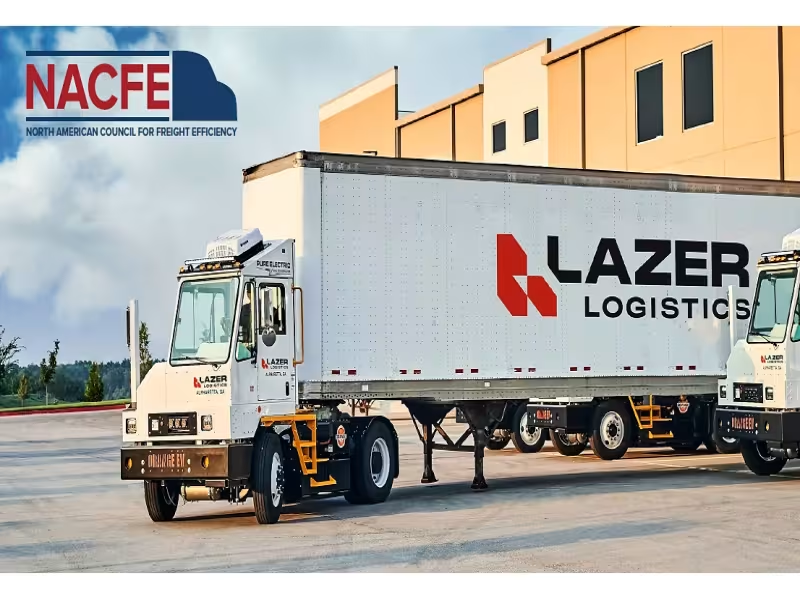
Fort Wayne, Ind. – September 24, 2026 -- Electric terminal tractors have graduated from pilot programs to standard fleet equipment, with 76% of surveyed operators now reporting real operating-cost savings over diesel, according to a new report from the North American Council for Freight Efficiency (NACFE).
Cost savings, not sustainability goals, now drive adoption decisions
The report, "Beyond The Pilot: Electric Terminal Tractor Adoption, Four Years Later," found direct economic benefit has overtaken environmental targets as the top-cited reason fleets deploy the vehicles. NACFE first examined the technology in its 2022 report, The Use Case for Terminal Tractors, and revisited the market this year to track how fleet behavior has shifted.
More than half of fleets have scaled beyond pilot testing
Among survey respondents, 54% have moved past pilot programs into partial deployment or full standardization of electric terminal tractors in their yards. NACFE surveyed 62 industry participants -- 44 fleet operators and 18 industry partners -- and supplemented the data with seven in-depth interviews.
Yard operations become the entry point for broader fleet electrification
58% of fleet operators either adopted electric terminal tractors before any other battery electric vehicle type or have electrified terminal tractors exclusively, using controlled yard environments as a lower-risk proving ground before electrifying on-road fleets.
One fleet's decade of data shows maintenance costs cut in half
A fleet with nearly ten years of side-by-side performance data reported roughly 50% lower maintenance cost per operating hour and 75% to 95% lower energy cost per operating hour compared to diesel equivalents. Trade press independently corroborated combined savings exceeding $5 million for that fleet.
"Today terminal tractors are a proven option for a growing number of fleets," said Bruce Stockton, NACFE's senior fleet consultant and one of the report's authors.
The report was produced in collaboration with Orange EV, which sponsored the research and helped facilitate interviews and survey participation but did not write any part of the report or supply its data, NACFE said. Zack Ruderman, Orange EV's vice president of sales and marketing, said fleet operators have shifted from questioning whether electric terminal tractors could perform the job to asking how quickly they can standardize around them.
New readiness tool scores fleets across seven adoption factors
NACFE released an interactive Terminal Tractor Electrification Readiness Tool that evaluates organizations on daily duty cycle, capital access, external motivators such as regulation, incentive availability, power and charging infrastructure, prior EV experience, and site control. The tool maps results to one of five readiness tiers, ranging from "strong candidate" to "not yet a fit."
The report includes seven case studies spanning outcomes from full standardization to fleets that decided against adoption. NACFE will host a webinar on October 7 at 2 p.m. ET to discuss the findings in detail.