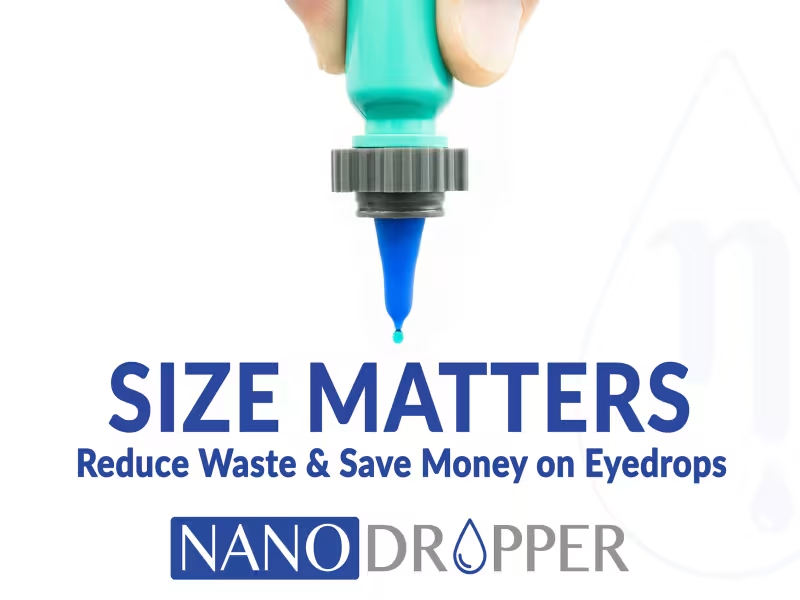
SHERIDAN, WYOMING - April 14, 2026 - Nanodropper has developed the only FDA-listed, volume-reducing adaptor for commercial eyedrop bottles, targeting a structural inefficiency in ophthalmic drug delivery that decades of clinical research have identified but pharmaceutical packaging has not resolved. The device attaches by twisting onto a compatible bottle and reduces dispensed drop volume by more than 60%. Standard eyedrop bottles produce drops approximately five times larger than the eye can absorb, causing up to 80% of each dose to be lost through facial overflow or tear duct drainage into systemic circulation. Clinical evidence indicates smaller drops deliver equivalent therapeutic effect while reducing systemic absorption and associated side effects.
Business Impact
The cost implications are significant for patients on chronic ophthalmic therapies. Prescription glaucoma medications such as Vyzulta carry a per-bottle cost approaching $300; users report extending a single bottle from approximately 75 days to more than 150 days of use, roughly halving per-treatment cost. User accounts cite annual savings approaching $300 across multiple concurrent drop regimens. For patients managing three or more ophthalmic medications simultaneously - a common scenario in conditions such as glaucoma - the compounding savings become a material factor in treatment adherence and access. The company frames its mission explicitly around removing financial barriers to prescription ophthalmic care, with particular emphasis on patients on fixed incomes or with limited drug coverage.
Clinical and Operational Basis
Clinical research spanning decades has established that smaller-volume eye drops maintain therapeutic efficacy. The primary rationale for continued large-volume dispensing appears to be packaging economics rather than clinical necessity. Nanodropper's adaptor intervenes at the point of dispensing without altering the medication itself. Because the device reduces the proportion of each dose absorbed systemically via tear duct drainage, it may also lower exposure to systemic side effects - a factor relevant for medications with known cardiovascular or systemic profiles. The product is available in two sizes to cover most standard eyedrop bottles, with compatibility verification available through the company.
Patient and Veterinary Applications
User reports extend the product's commercial relevance beyond the core human glaucoma patient population. The adaptor has been applied in veterinary contexts - notably for small cats and dogs with glaucoma - where standard drop volumes cause drainage discomfort and systemic irritation due to small ocular surface area and body mass. Caregivers administering drops to elderly or mobility-limited patients cite improved application accuracy and near-elimination of facial overflow as practical operational benefits. A retired registered nurse endorsed the device on clinical grounds, citing ingenuity and consistent performance across bottle types. These use cases indicate an addressable population broader than the primary glaucoma demographic alone.
Key facts:
- Nanodropper is the only FDA-listed volume-reducing adaptor for eyedrop bottles
- Standard eyedrop bottles dispense approximately five times the volume the eye can absorb; up to 80% of each dose is wasted
- The adaptor reduces dispensed drop size by more than 60% without modifying the medication
- Users report extending single glaucoma medication bottles from approximately 75 to over 150 days of use
- Prescription glaucoma drops such as Vyzulta cost close to $300 per bottle
- Available in two sizes to fit most standard commercial eyedrop bottles