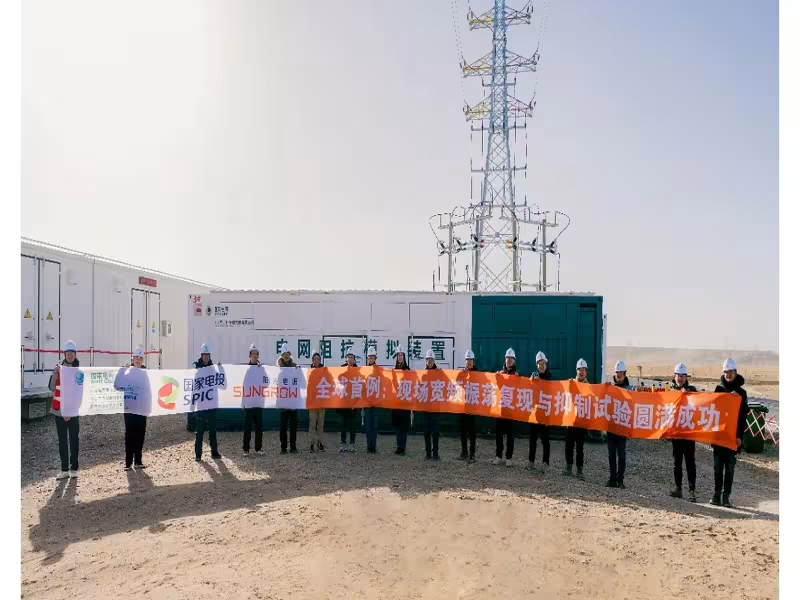
Hefei, China – September 19, 2026 -- Sungrow has become the first company to controllably reproduce and suppress wideband oscillation at a real-world 500 MW solar-plus-storage plant in Qinghai, China, addressing a grid-stability risk that has previously caused multi-month outages and mass disconnections in Europe.
Past oscillation events cost utilities months of downtime and millions of users
In 2014, Germany's BorWin1 offshore HVDC project suffered oscillations at 250-350 Hz that damaged filter capacitors and forced a shutdown lasting roughly six months. In 2019, the Hornsea offshore wind farm in the UK experienced subsynchronous oscillation that triggered widespread disconnection, wiping out about 3.2% of system load and affecting roughly one million users.
Field test reproduced oscillation under controlled weak-grid conditions
Working with industry partners, Sungrow deployed PV inverters across the Qinghai site and established weak-grid conditions to isolate three contributing factors: power output, system short-circuit ratio (SCR), and control parameters. The team then achieved controlled reproduction of a localized system oscillation, a validation step that had previously been confined to theoretical and simulation work.
Inverters stabilized voltage and frequency within 40 milliseconds
Using Sungrow's patented grid-strength adaptation technology, the inverters identified grid strength within 40 milliseconds, adjusted control strategies in real time, and rapidly stabilized voltage and frequency. The test also confirmed that Sungrow's grid-forming control strategy maintains stable operation across an SCR range of 1 to 40 while mitigating transient overvoltage.
Result moves oscillation suppression from lab research into plant operations
Sungrow said the successful reproduction and suppression of wideband oscillation at a 500 MW commercial plant marks a shift of the technology from laboratory testing into engineering practice, with potential to improve stability under extremely weak grid conditions, prevent oscillation-triggered disconnections, unlock additional export capacity for plants tied to weak grids, and cut generation losses.
Pan Nian'an, Chief Engineer and Chief Expert for Utility PV BU at Sungrow, said autonomous fault self-healing and grid-support capabilities are essential for renewable energy to become a stable and reliable power source, and that the company will continue R&D on wideband oscillation suppression, grid-forming control, and multi-energy coordination.