Thought Leadership

Digital Diagnostics: Autonomous AI Avoided 91% of Needless Referrals

Image
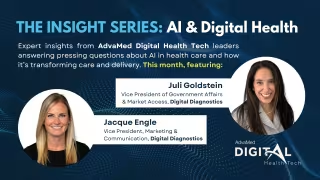
Digital Diagnostics: Autonomous AI Avoided 91% of Needless Referrals

United States – October 17, 2026 -- Digital Diagnostics says its LumineticsCore system avoided 91% of unnecessary specialty visits in a pivotal clinical trial and cut time-to-follow-up for positive patients from 60 days to 5 days. The company made the claims in AdvaMed's "The Insight Series: AI & Digital Health," speaking through Jacque Engle, Vice President of Marketing & Communication, and Juli Goldstein, Vice President of Government Affairs & Market Access.


eCheck Payments Can Cut Cash-Flow Delays for New Hampshire Firms

Image
eCheck Payments Can Cut Cash-Flow Delays for New Hampshire Firms

Manchester – October 17, 2026 -- HelloNation has published an article featuring Eric Miltner of PayPact in Manchester, New Hampshire, arguing that eCheck payments can speed collections and reduce manual work for local small businesses still relying on paper checks.

Paper checks slow cash flow and add error risk for New Hampshire businesses

Mailing, depositing and manual recordkeeping extend the payment cycle, according to the article. Contractors, medical offices, property managers and professional service firms are most exposed to delays from mail delivery, manual deposits or payment posting errors.

eCheck payments move through the ACH network, but the terms are not identical

An eCheck is the customer's payment method, drawing funds directly from a checking or savings account. ACH is the bank network that processes the transfer. The article stresses that the two terms are often used interchangeably but describe different things.

CGI Pushes Continuous AI Sensing to Replace Periodic Change Surveys

Image
CGI Pushes Continuous AI Sensing to Replace Periodic Change Surveys

Global – October 16, 2026 -- CGI is advocating "continuous organizational sensing," an AI-based approach that replaces periodic surveys, workshops and retrospective reports as the way leaders track employee adoption of transformation programs.

Existing data sources go unused during transformations

The core problem is timing, not volume. Collaboration platforms, help desk tickets, training feedback, meeting transcripts and open-text comments all carry signs of how change is unfolding. Organizations often analyze them only after the fact, or leave them untapped because of privacy and sensitivity constraints.

CGI lists four blind spots in traditional change management: data that is delayed, fragmented across systems, open to individual interpretation, and analyzed manually after the fact.

ChurnZero: CS Teams Should Phase In AI, Not Automate Everything

Image
ChurnZero: CS Teams Should Phase In AI, Not Automate Everything

Global – October 13, 2026 -- ChurnZero CEO You Mon Tsang predicts the average customer success manager (CSM) will gain 25-50% more bandwidth per day by the end of 2026 through AI, provided teams avoid the most common adoption error: automating the whole operation at once.

ChurnZero VP of Customer Success Lukas Alexander laid out the argument on the “Customer Success Talks” podcast. He cited two obstacles. The first is AI overreach, where handing too much decision-making to AI could damage long-term customer relationships. The second is balancing automation with a personal touch, because CS teams depend on lasting partnerships rather than the transactional relationships typical of sales and marketing.

DisposeRx CEO Warns Medication Safety Gap Persists After Treatment Ends

Image
DisposeRx CEO Warns Medication Safety Gap Persists After Treatment Ends

Southern Pines, N.C. – – October 03, 2026 -- DisposeRx CEO William Simpson is pressing the healthcare industry to extend medication safety protocols beyond the point of prescribing, arguing that leftover drugs left in home medicine cabinets create unmanaged risk once a treatment course concludes.

Simpson says current safety standards stop short of covering the full prescription life-cycle.

In a new commentary, Simpson questions whether the same rigor applied when a patient begins therapy is matched when a condition improves, a dosage changes, one medication replaces another, a physician deprescribes a no-longer-necessary therapy, an antibiotic course ends, or a patient is discharged from the hospital with an altered regimen.