AI Infrastructure

Synteq Opens Toronto Site, Its Sixth, in Telehouse Canada Deal

Image

Synteq Opens Toronto Site, Its Sixth, in Telehouse Canada Deal

TORONTO – October 27, 2026 -- Synteq has opened its first Canadian location in Toronto, its sixth site overall, through a partnership with Telehouse Canada. The GPU cloud provider cited growing customer demand for Northeast and Canadian capacity.

Toronto joins five existing Synteq sites in the US and Bulgaria

The new location follows Spokane, Chicago, Dallas-Fort Worth, Valley Forge and Sofia, Bulgaria. CEO Eric Yingling said the move was driven by "organic demand from our client base." He added that Toronto offers the power density current GPUs need, plus connectivity suited to Northeast US and Canada-focused workloads.

Compal, ARC Cloud Sign MOU Targeting Up to 100 MW AI Data Centers

Image
Compal, ARC Cloud Sign MOU Targeting Up to 100 MW AI Data Centers

San Jose – October 27, 2026 -- Compal Electronics (TWSE: 2324) and ARC Cloud have signed a non-binding memorandum of understanding to explore a data center development roadmap of up to 100 MW for large-scale AI computing infrastructure.

Compal and ARC Cloud sign framework MOU at 2026 OCP Global Summit

The MOU establishes a framework for collaboration across multiple projects. It aligns with ARC Cloud's plans for continued capital investment in AI infrastructure and data center development across the United States, including California, Nevada, Texas and Georgia.

The partnership extends beyond AI server supply to system engineering, technical validation, deployment coordination and ongoing support. The stated aim is to accelerate delivery of computing capacity for AI model training, fine-tuning and inference.

GF Maps Cloud-to-Edge Chip Portfolio for AI Workloads

Image
GF Maps Cloud-to-Edge Chip Portfolio for AI Workloads

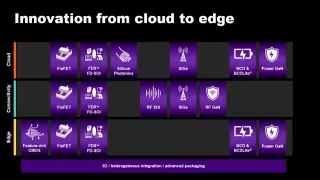
Global – October 22, 2026 -- GF has laid out a cloud-to-edge portfolio of essential chips for AI, spanning silicon photonics, power delivery, advanced packaging, RF, embedded memory and low-power compute, in a talk at CEA-LETI.

The company ties the portfolio to AI use cases in autonomous driving, healthcare, robotics and industrial automation.

GF targets GPU connectivity and data center power in the cloud

Connecting more GPUs for more powerful AI models requires higher data rates, which GF addresses with Fotonix silicon photonics and optical networking.

For data centers seeking sustainable power and lower CO2 emissions, GF points to GaN, BCDLite and FinFET technologies. They provide low transmission loss power delivery and fast transient response voltage regulation.

NEDO Backs NTT-Led Push for Mass-Produced Optical Chiplets

Image
NEDO Backs NTT-Led Push for Mass-Produced Optical Chiplets

Tokyo – October 20, 2026 -- A four-company consortium led by NTT Innovative Devices has been selected for a NEDO-backed project to build mass-production technologies for optical chiplets, with a target of more than a tenfold gain in manufacturing productivity over current R&D-stage processes.

Four manufacturers join the NEDO-selected consortium

The members are NTT Innovative Devices, Japan Semiconductor Corporation, Furukawa Electric and Shinko Electric Industries. NTT, Inc. participates as an advisor. The project falls under the New Energy and Industrial Technology Development Organization's program for enhanced post-5G information and communication infrastructure, specifically its development of manufacturing technologies for advanced semiconductors. Japan Semiconductor is a wholly owned subsidiary of Toshiba Electronic Devices & Storage Corporation.

3D TSV, 2.5D Packaging Market to Reach $21.5B by 2035 on AI Demand

Image
3D TSV, 2.5D Packaging Market to Reach $21.5B by 2035 on AI Demand

London – October 19, 2026 -- The global 3D through-silicon-via (TSV) and 2.5D packaging market will grow from USD 9.46 billion in 2025 to USD 21.50 billion by 2035, according to Credence Research. That implies a compound annual growth rate of 8.50% for 2026-2035. The figures are the firm's proprietary model estimates, not audited supplier sales totals.

HBM and data centers account for the largest share of spending

High-bandwidth memory (HBM) and other memory made up 46.0% of 2025 application revenue. Data centers and high-performance computing held 55.0% of end-use spending. By technology, 2.5D integration led with 38.0% of 2025 value, and die-to-wafer integration accounted for 48.0%.

Hyperscalers Top $700B on Compute as Chip Scaling Laws Stall

Image
Hyperscalers Top $700B on Compute as Chip Scaling Laws Stall

United States – October 19, 2026 -- Six of the largest hyperscalers are on track to spend more than $700 billion on computing infrastructure this year, about double the record set in 2025, as gains from shrinking transistors fade and performance is bought by building bigger systems.

Brute-force scaling replaces transistor shrinkage as the main source of progress

The spending goes into new data center sites faster than the electrical grid can feed them. Progress now comes mostly from adding chips, memory, power and cooling rather than from smaller transistors. In AI, training compute has doubled roughly every six months since 2010, far faster than Moore's Law allows, and little of that growth comes from shrinking.

Arelion Delivers Multi-Terabit Capacity on Helsinki–Warsaw Route

Image
Arelion Delivers Multi-Terabit Capacity on Helsinki–Warsaw Route

Stockholm – October 19, 2026 -- Arelion has provisioned multi-terabit capacity on its Helsinki–Warsaw route and onboarded several new enterprise and wholesale customers, one year after launching its fully diverse Baltic corridor in October 2025.

Demand rises across financial services, cloud and hosting

Since the October 2025 launch, demand has accelerated across financial services, cloud, hosting and digital platforms, according to Arelion. The carrier has deployed several new high-capacity services across the Baltic region, including wavelengths, Ethernet and IP Transit. It attributes the rising performance requirements to AI and cloud workloads.

PUFsecurity's PUFrt Wins OCP S.A.F.E. Approval for AI Data Centers

Image
PUFsecurity's PUFrt Wins OCP S.A.F.E. Approval for AI Data Centers

San Jose – October 19, 2026 -- PUFsecurity, a subsidiary of eMemory Technology, has received OCP S.A.F.E. approval for its PUFrt root-of-trust IP after an independent Scope 3 security assessment, and the product is now listed on the OCP Marketplace.

The company presented PUFrt at Microsoft's Caliptra Workshop on October 12, the opening day of the sold-out 2026 OCP Global Summit. The workshop drew nearly 400 attendees. Principal Security Architect Kent Chuang spoke on moving the open-source Caliptra specification into production-ready silicon for AI data centers.

Lightelligence Unveils dOCS Silicon Photonic Optical Switch Module

Image
Lightelligence Unveils dOCS Silicon Photonic Optical Switch Module

Global – October 19, 2026 -- Lightelligence has presented dOCS, an optical circuit switching (OCS) interconnect module that it says is built on the world's first silicon photonic OCS chip, aimed at AI clusters, GPU superclusters and high-performance computing (HPC) systems.

dOCS integrates optical switching into a QSFP-DD module

The module embeds switching directly in the interconnect. Signals can be routed through external optical ports or through internal cross-connections.

Lightelligence built the chip with its proprietary integrated photonic integrated circuit (PIC) technology. The built-in switching function links xPUs in a QSFP-DD form factor, which the company describes as deployment-friendly.

Morgan Stanley Sees Over Half of Cloud Capex Going to Memory

Image
Morgan Stanley Sees Over Half of Cloud Capex Going to Memory

Shenzhen – October 18, 2026 -- More than half of cloud data center capital expenditure is expected to go to memory and storage, excluding HBM, by 2027, according to a projection by Morgan Stanley's Daniel Yen presented at the 5th GMIF Innovation Summit. The forum, themed "The Future Built on AI Memory and Storage," was co-hosted by the Shenzhen Memory Industry Association (SMIA) and Peking University's School of Integrated Circuits at the Renaissance Shenzhen Bay Hotel.

Yen said global data center capex will stay strong in the coming years. He named six paths to overcome the "memory wall": process migration, design changes, advanced packaging, memory peripherals, PIM/CIM and new materials.