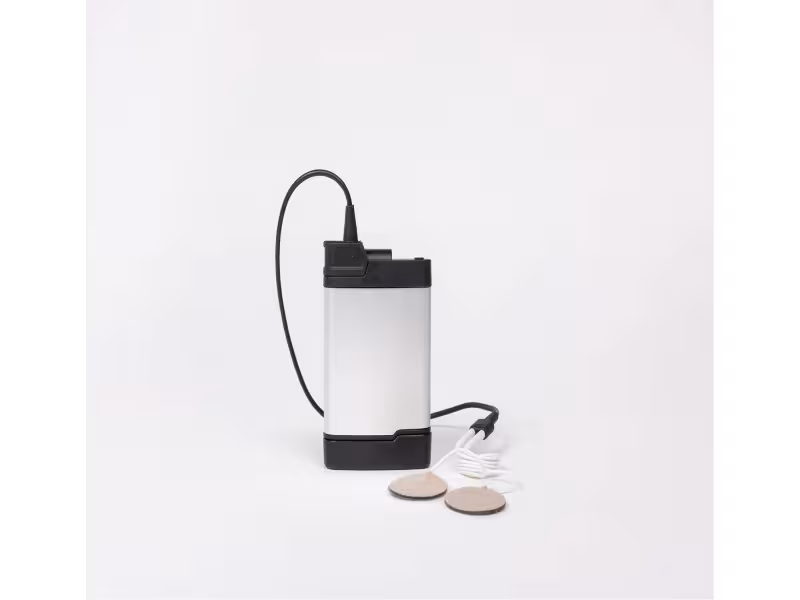
Jacksonville, Florida – September 23, 2026 -- Theragen presented machine-learning findings at the Society for Minimally Invasive Spine Surgery (SMISS) 2026 Annual Forum showing that daily wear time of its ActaStim®-S bone growth stimulator predicts clinically meaningful pain improvement after spinal fusion surgery, with benefits plateauing around 13 hours of daily use.
Nearly 7,000 patients and 195,000 patient-days of data feed predictive model
The analysis drew on almost 7,000 patients and approximately 195,000 patient-day observations collected through ActaStim-S, a wearable electrical stimulation device paired with a digital health platform. A standardized device-to-electronic medical record pipeline achieved 99.2% data completeness across the dataset, according to Theragen.
XGBoost model outperforms standard logistic regression
An XGBoost machine-learning model outperformed a standard logistic-regression baseline across all reported metrics in predicting minimal clinically important difference (MCID) in pain. The model achieved a 96.4% negative predictive value, a result Theragen said could support early identification of patients unlikely to achieve meaningful pain improvement, pending external validation.
Wear adherence emerges as strongest modifiable predictor
Bone growth stimulator wear adherence was identified as the strongest modifiable predictor of clinically meaningful pain improvement, with predicted gains rising alongside daily wear time up to roughly 13 hours before leveling off. Baseline pain severity was the strongest overall predictor of achieving MCID, as patients starting with higher pain levels showed greater room for measurable improvement. Multilevel fusion and transforaminal lumbar interbody fusion (TLIF) were linked to higher likelihood of non-improvement, while patients tracking below the 13-hour threshold at six weeks postoperatively were flagged as candidates for additional adherence counseling.
Patient and surgical factors shape divergent pain trajectories
A third poster introduced stratified clinical significance tiers to capture both magnitude and direction of longitudinal pain change beyond a single pass/fail MCID threshold. Degenerative disc disease, diabetes and renal disease were associated with improvement at six weeks, while anterior lumbar interbody fusion (ALIF) was associated with improvement at six months. Pseudoarthrosis, tobacco use and spinal stenosis were associated with persistent pain, though Theragen noted effect sizes were generally modest, reflecting the multifactorial nature of postoperative recovery.
Chris McAuliffe, CEO of Theragen and co-inventor of ActaStim-S, said the device was designed to "listen" to recovery data rather than simply deliver therapy. Ryan D. Snowden, MD, an orthopedic surgeon at Tennessee Orthopaedic Alliance in Nashville, said longitudinal real-world data could help clinicians identify recovery patterns early and tailor postoperative support.