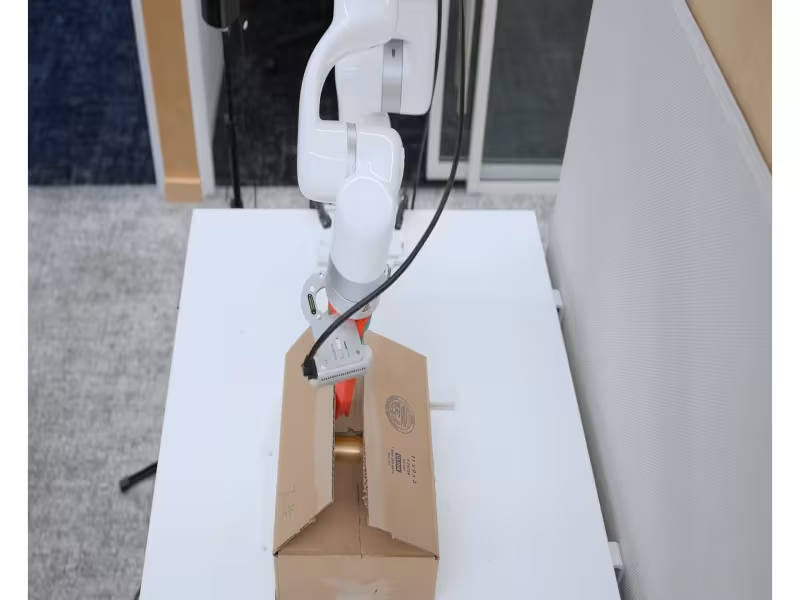
Pittsburgh – September 22, 2026 -- Viam will debut BoxBot, a robot arm that opens taped cardboard boxes, at IROS 2026 in Pittsburgh, running September 27 through October 3. The system was trained on just 125 teleoperated demonstrations collected in roughly five hours over four days, using a fine-tuned open-source vision-language-action model with no custom architecture required.
BoxBot combines visual servoing with a fine-tuned SmolVLA model on one data path
The robot uses image-based visual servoing to guide a cutting tip along tape seams typically 1 to 2mm wide, since no two sealed boxes present identical geometry. A fine-tuned SmolVLA model then handles the contact-rich task of peeling open and adjusting four box flaps. Both systems run as native services on the same machine, with the VLA policy inferring locally on an NVIDIA Jetson Orin Nano through Viam's ML model service.
Two engineers collected training data in five hours using VR teleoperation
Two Viam engineers gathered BoxBot's 125 demonstrations using a VR controller, with Viam syncing the arm data and two camera streams to the cloud. The team fine-tuned SmolVLA with LeRobot on Hugging Face Jobs and deployed the resulting policy directly back to the robot, without building task-specific engineering or a custom model architecture.
Code and dataset are published on Hugging Face for reproduction
Viam has made the code and dataset publicly available at huggingface.co/viamrobotics, allowing researchers to train on the data, benchmark against BoxBot, or replicate the setup independently.
Bradshaw frames the project as a case for hybrid manipulation architectures
"The question isn't whether to use a VLA, it's where," said Shannon Bradshaw, Ph.D., SVP of Product and Education at Viam. He said learned policies suit contact-rich manipulation tasks that resist analytical modeling, while visual servoing enables precise solutions in dynamic environments, and that Viam's platform lets the team combine hardware, software, and models into one system they can iterate on without ad hoc scripting.
IROS attendees can operate the same VR rig used to train BoxBot
At Booth 828, attendees can watch BoxBot cut tape seams and open flaps, drive the arm themselves at a VR teleoperation station using the same setup that produced BoxBot's training data, and test an SO-101 leader-follower station that records and replays episodes visible in the Viam app. Developers connect hardware in JSON, write logic in Python, Go, or TypeScript, and pull modules from the Viam Registry, with ROS 2 teams able to run Viam alongside existing robots through the viam-ros2-integration module.