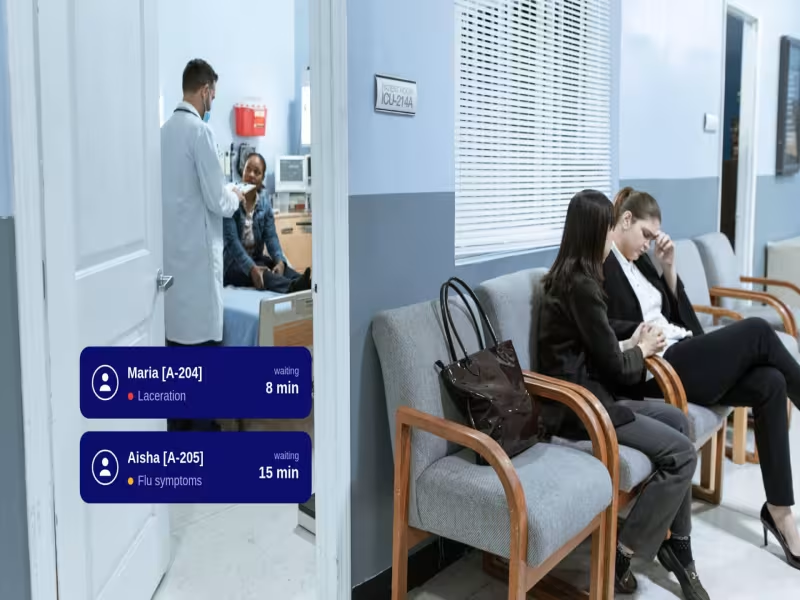
North America – October 27, 2026 -- WaitWell ranks first at 9.4/10 in a nine-platform comparison of urgent care queue management systems published on its own website, ahead of Solv Health at 8.2, QLess at 7.4 and Qminder at 7.2.
The evaluation scored platforms on remote patient check-in, walk-in queue management, appointment scheduling integration, HIPAA compliance, EHR connectivity, multi-location visibility and pricing transparency. Its stated goal is reducing left-without-being-seen (LWBS) events, which the guide calls the most expensive operational failure in urgent care.
WaitWell starts at $29 per location but lacks native Epic and Cerner links
WaitWell manages walk-in queues and booked appointments in one system. Patients check in by phone, kiosk or web link and receive a notification when it is their turn. Starter costs $29 per month per location and Basic $55. Enterprise and Campus plans are custom-priced and add Waillo AI, SSO, API access and SLA guarantees. All plans include unlimited staff accounts and a HIPAA BAA.
The platform is SOC 2 Type 2 certified, and onboarding takes two to four weeks. Waillo Insights provides cross-location dashboards covering wait times, throughput, LWBS trends and staffing pressure per site.
The guide acknowledges that WaitWell does not offer native bidirectional EHR integration with systems such as Epic or Cerner out of the box. Enterprise plans include webhooks and full API access. Single-site clinics that need only an SMS waitlist may find ScanQueue or NextMe faster to deploy and less expensive. Dallas Animal Urgent Care uses WaitWell to replace lobby waiting with a virtual queue.
Solv Health scores 8.2 on EHR depth but withholds pricing
Solv Health integrates natively with Epic, AthenaHealth and Cerner and has powered over 100 million visits. Its AI agents include Maya, which answers calls around the clock and books visits, and ClearPay, which handles real-time insurance eligibility and cost estimates. Partner-reported results include a 50% call reduction, 2-3 incremental visits per clinic per day, 75% digital registration adoption and patients seen up to 46% faster.
Pricing is custom per location and unpublished, and EHR integration is included or extra depending on the package. The Solv marketplace drives patient acquisition but lists a clinic alongside competitors. The guide names Solv the pick for US urgent care chains needing deep EHR integration, and ScanQueue the top choice for independent clinics wanting triage-aware queuing with minimal setup.
QLess carries vendor-stability risk after exiting Chapter 11 in September 2024
QLess filed for Chapter 11 bankruptcy in June 2024 and exited in September 2024. It scored 7.4 and serves 300+ cities and counties and 200+ colleges and universities. Its platform covers walk-in queuing, appointments, callback queuing and virtual meetings, with machine-learning wait time forecasts.
Pricing is unpublished and historically cited as expensive by enterprise buyers. Reviews cite difficulty changing configurations without vendor support and the lack of a test environment. The platform has no native staff scheduling or integrated payments.
Qminder scores 7.2 with iPad kiosk check-in and service analytics
Qminder is built around iPad kiosk check-in, a staff queue dashboard, and manager insights into wait times, service durations and staff performance. The guide recommends it for urgent care centers with structured walk-in environments.