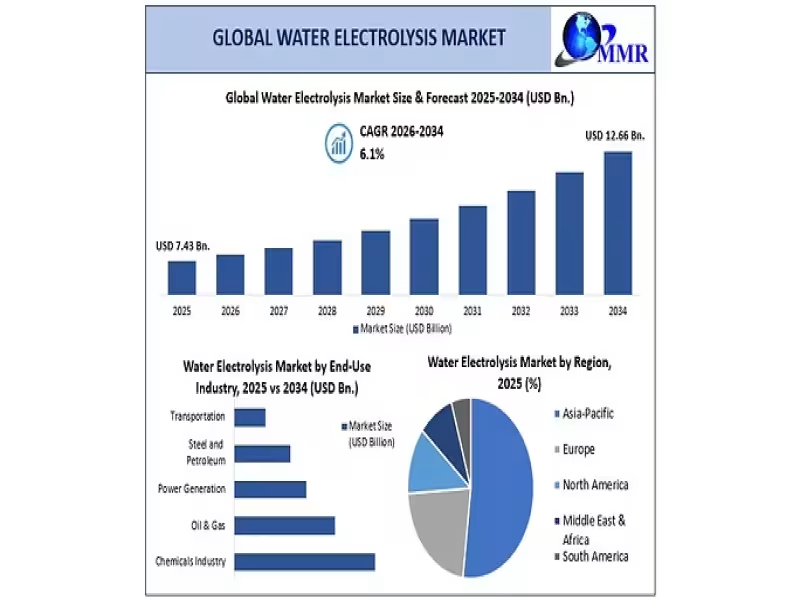
Pune – October 01, 2026 -- The global water electrolysis market reached USD 7.43 billion in 2025 and is projected to climb to USD 12.66 billion by 2034, a 6.1% CAGR through the forecast period, according to a new report from Maximize Market Research (MMR).
Installed electrolysis capacity more than doubled to above 4 GW in 2025
Global installed electrolysis capacity surpassed 4 GW last year, with over 2.5 GW under construction and targeting operation in 2026. Capital spending on low-emissions hydrogen projects reached nearly USD 7 billion in 2025, almost double the 2024 figure, with electrolysis-based projects capturing the larger share of that total.
Manufacturing capacity of 38 GW dwarfs actual 4 GW output, exposing a utilization gap
Global electrolyzer manufacturing capacity hit nearly 38 GW per year in 2024, up 40% year on year, while actual production totaled only around 4 GW -- implying utilization of roughly 10%. Around 26 GW of electrolysis capacity had reached final investment decision or entered construction with operation planned by 2030, but more than 100 GW of announced capacity risks missing that target unless investment decisions are secured before the end of 2027.
Alkaline technology holds the largest share while PEM is set to grow fastest
Alkaline electrolysis remains the dominant technology on commercial maturity, lower capital requirements and suitability for large-scale production. PEM electrolysis is forecast to expand faster due to its compact design and compatibility with variable solar and wind input. Industrial feedstock applications -- spanning ammonia, methanol and petroleum refining -- led all application segments in 2025.
China accounted for nearly three-quarters of new electrolysis installations in 2025
Asia-Pacific led global deployment, with China representing close to 60% of worldwide electrolyzer manufacturing capacity and almost 75% of new installations added in 2025. India is building out green hydrogen capacity for refining and fertilizer production, while Japan and South Korea are targeting power generation and fuel applications. Australia is advancing large renewable-hydrogen projects, and Indonesia, Malaysia and Vietnam are pursuing ammonia, methanol and steel decarbonization.
EU targets 40 GW of domestic electrolyzer capacity by 2030
More than 2 GW of European electrolysis projects reached final investment decision between September 2023 and August 2024, with Germany, Spain, the Netherlands and France leading development across refining, chemicals and steel. Saudi Arabia's NEOM Green Hydrogen Project is targeting approximately 2.2 GW of electrolyzer capacity by 2027, while North America is scaling activity through hydrogen hubs and industrial decarbonization incentives.
Recent industry moves point to a shift toward regional manufacturing
Nel ASA entered a framework agreement with Hydrasun in September 2026 to build European assembly and integration capacity for modular PEM electrolyzers. Thyssenkrupp Nucera and BHEL signed a July 2026 collaboration to localize alkaline electrolyzer module fabrication in India. BASF commissioned Germany's largest green hydrogen facility at Ludwigshafen in May 2026 using Siemens Energy PEM technology, and ITM Power secured a £46.5 million UK government grant in July 2026 to expand its Chronos electrolyzer manufacturing capability.
Low-emissions hydrogen output remains just 1% of total global demand
Global hydrogen demand surpassed 100 million tonnes in 2025, yet low-emissions hydrogen production reached only almost 1 million tonnes -- roughly 1% of the total. High electrolyzer costs, electricity requirements, project delays, financing constraints and uncertain hydrogen offtake continue to slow commercial deployment.