Cambridge, Mass. – September 30, 2026 -- Biopharma companies are losing time and money to a recurring pattern of disconnected experiments and manual data reconciliation that Zifo calls the 'DMTA doom loop,' according to a new position paper from the scientific informatics firm.
Zifo identifies a structural flaw in the Design-Make-Test-Analyse process
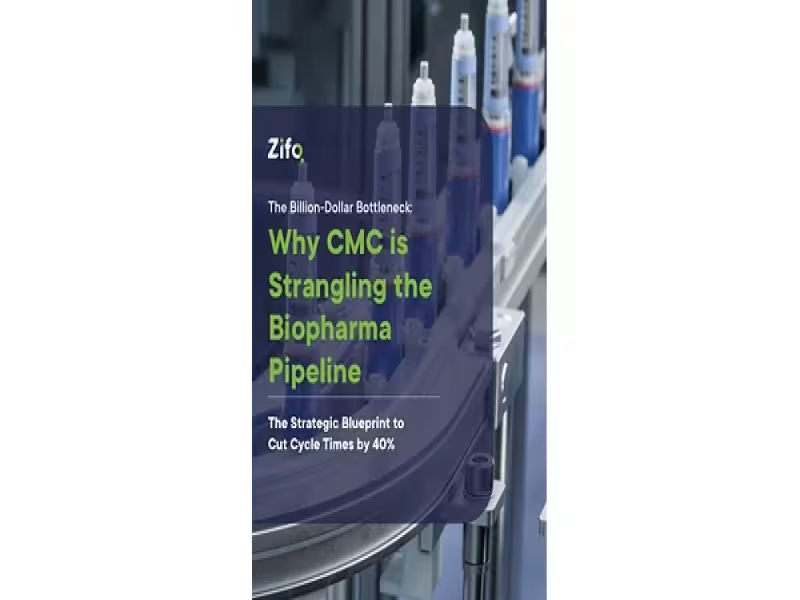
The paper, titled 'The Billion-Dollar Bottleneck: Why CMC Is Strangling the Biopharma Pipeline,' argues that the DMTA cycle used in chemistry, manufacturing and controls (CMC) work is forced into a rigid, linear execution model rather than adapting to what the science actually requires. Zifo says evidence in many CMC environments is scattered across scientific applications, instruments, spreadsheets, PDFs, batch records and individual expertise, forcing scientists to reconstruct experimental histories and decision reasoning before they can even begin new work.
Lost scientific context, not just fragmented data, drives the slowdown
Zifo states the core problem is not fragmented data alone but the loss of scientific context and decision knowledge as information moves between systems, teams and lifecycle stages. When results are separated from their samples, methods and decision history, the DMTA cycle keeps running operationally while ceasing to function effectively for learning.
Digitizing old workflows will not fix the bottleneck, paper warns
The position paper cautions against simply moving paper- or spreadsheet-based processes into rigid digital templates, warning this can produce a faster version of the same fragmented process and push scientists toward ungoverned workarounds. Instead, Zifo calls for reimagining DMTA as a connected network in which scientists can move between design, make, test and analyse steps in any order, with historical data, methods and decisions remaining linked to every sample and result.
Zifo proposes an orchestration layer instead of a single monolithic platform
Rather than replacing validated core systems, the paper recommends an orchestration layer that connects scientific activity across existing systems of record, capturing and reusing information across any DMTA step. It also proposes governed Scientific Language Models (ScLM) built on proprietary scientific evidence to help organizations interact with their own scientific knowledge while retaining traceability to underlying data.
Recommended rollout targets choke points, not wholesale system replacement
Zifo recommends targeted integrations and lighthouse implementations across CMC, process development, analytical development, quality, manufacturing, IT and scientific informatics functions, prioritizing operational choke points where reconnecting evidence delivers the most value. The paper argues this allows scientists to skip unnecessary stages -- moving directly from Design to Analyse, or from Analysis back into wet-lab execution -- when the underlying knowledge base is already contextualized, breaking the linear delay built into traditional CMC value chains.