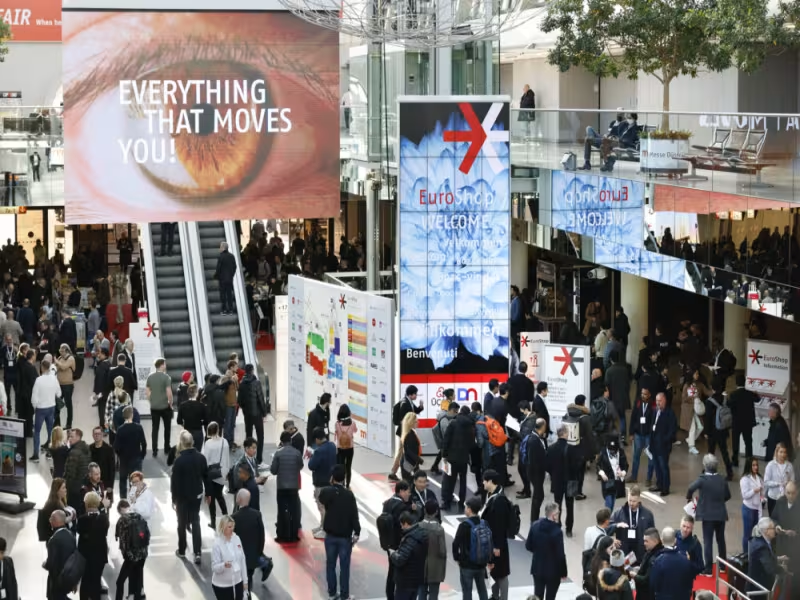
SHERIDAN, WYOMING - February 21, 2026 - EuroShop 2026 is set to return to Düsseldorf from February 22 to 26 as the event marks its 60th anniversary and positions the show as a global platform for retail innovation and cross-discipline sourcing. The organizer expects around 1,900 exhibitors from more than 60 nations across over 100,000 square meters in 14 halls, reflecting continued investment cycles in store formats, retail technology, energy efficiency, and customer experience. For retailers, shopfitters, architects, and solution providers, the anniversary edition is framed as both a business marketplace and a curated "Global Retail Festival" designed to accelerate partnerships and project planning for the next three-year cycle.
A 60-Year Platform for Retail Decision-Makers
EuroShop's anniversary framing is not only symbolic; it is intended to reinforce the show's role as a planning anchor for international retail projects. Since its first edition in 1966, the event has evolved into a broad, multi-discipline meeting point that brings together store design, technology, marketing, and operations under one roof. The 2026 edition emphasizes practical relevance for decision-makers in retail organizations as well as for architecture and design offices, shopfitting and store planning specialists, and suppliers that support implementation at scale.
From an operator perspective, the show's value is the ability to compare solutions side-by-side across multiple retail disciplines while aligning internal stakeholders around investment priorities. For suppliers, the scale and international participation are positioned as a route to meet buyers who are actively evaluating new concepts and rollout-ready technologies.
Seven Retail Dimensions Reflect Where Investment Is Concentrating
EuroShop 2026 is structured around seven "experience dimensions" intended to map to the core disciplines that shape modern retail. The largest area is Shopfitting & Store Design, with around 450 exhibitors and more than 27,000 square meters registered, spanning store concepts, visual merchandising, materials, furniture, and modular point-of-sale systems.
Other dimensions reflect major retail change drivers and operational requirements:
- Lighting, positioned as a visitor-facing showcase of how illumination can shape store atmosphere and merchandising impact.
- Expo & Event Marketing, expanding due to high demand and moving to two halls for the first time.
- Refrigeration & Energy Management, planned at over 25,000 square meters, reflecting focus on energy-efficient technology and sustainable cooling.
- Food Service Equipment, covering cooking and baking, convenience systems, food technology, and to-go solutions as retail gastronomy continues to expand.
- EuroCIS (Retail Technology), with more than 550 exhibitors highlighting AI, customer centricity, smart stores, and other retail tech themes.
- Retail Marketing, focused on multisensory in-store campaigns and formats designed to strengthen purchase impulses and experience-led retail.
Special Areas and Formats Aim to Speed Up Sourcing and Concept Decisions
Beyond hall structuring, EuroShop 2026 adds and expands special areas designed to help buyers and planners quickly identify relevant solutions. The Designers' Village highlights international architecture offices and design studios with concept-driven approaches. A new VM Experience area is introduced to make visual merchandising more interactive, dialog-based, and creatively accessible for practitioners.
Additional special areas are positioned around specific retail operational themes, including digital transformation and automation in retail gastronomy, as well as the role of lighting in store design. Returning villages and hubs broaden community and partner discovery, while a "60's Lounge" is planned to connect the anniversary narrative to the event's origins.
For procurement and project teams, these formats function as structured entry points that reduce time-to-comparison across multiple categories, especially when projects require coordination between design intent, technical feasibility, and operational constraints.
Stage Program and Guided Tours Support Operational Takeaways
EuroShop 2026 is planned with seven stages featuring trends, case-driven sessions, and specialist contributions from retailers and exhibitors. The emphasis is on knowledge exchange around future-facing topics for international retail, supported by discussion formats intended to connect strategy with implementable practices.
Guided Innovation Tours are expanded for the anniversary edition, with tours built around defined focus themes:
- Sustainable Materials and Store Design
- Retail Tech Innovation
- Energy Management and Optimization
- Food Service innovations
In addition, store tours in Düsseldorf are planned for the first time, extending the show experience into real retail environments. For operators, this combination can help translate trade-fair discovery into practical benchmarking and internal decision support.
Key Themes: AI, Digitalization, Experience, and Sustainability
Across the 2026 positioning, the recurring priorities include AI and digitalization, emotionalization of retail experiences, and sustainability. In practical terms, these themes connect to both revenue and cost drivers: technology and customer centricity for conversion and loyalty, and energy optimization and sustainable materials for operating efficiency and compliance readiness.
For multi-site retailers and project stakeholders, the show's breadth can be used to validate which innovations are mature enough for rollout planning versus which are still best suited for pilots. The overall proposition is a full-spectrum view of retail innovation across customer-facing and back-end decision domains.
Learn more about EuroShop 2026 at https://www.euroshop.de.