SHERIDAN, WYOMING - February 21, 2026 - EuroShop 2026 has published its stage program, positioning the event's conference content as a practical orientation tool for retail decision-makers preparing for technology adoption, format upgrades, and customer-experience investments. The organizer is planning more than 270 free presentations across seven curated stages, with formats ranging from keynotes and panels to use cases. The program brings together international retail experts, brands, and start-ups, and adds an experimental stage concept developed by Hochschule Düsseldorf students-an approach designed to connect strategic themes like AI and sustainability with real-world retail applications.
A Large-Scale Knowledge Program Designed for Retail Execution
EuroShop's 2026 stage agenda is presented as one of the most extensive conference programs in the sector, with content designed to translate trends into operational choices. Topics span AI applications, technology roadmaps, data-driven processes, retail and event marketing, store design, food service, and sustainability-led concepts. For retail operators and solution providers, the format supports faster benchmarking: teams can compare different approaches to omnichannel, in-store digitalization, and experience design while aligning internal stakeholders on priorities for pilots and rollouts.
The listed participants include retailers and brands such as OTTO, OBI, dm, Douglas, Thalia, POCO, EDEKA, Manufactum, and Veseloglu, indicating a strong focus on practical, retailer-relevant perspectives rather than purely conceptual forecasting.
Seven Stages Map to Core Retail Investment Areas
The seven stages are positioned as seven perspectives on "retail of tomorrow," with each stage aligned to a specific set of business decisions:
- Yellow Stage (Hall 1): focuses on expo and event marketing, including how brands use live communication and storytelling to create emotional experiences and longer-term customer connections.
- Purple Stage (Hall 4): centers on retail marketing themes, including international trends and AI-supported, multisensory point-of-sale concepts.
- Red Stage (Hall 6): emphasizes digital transformation with concrete projects across omnichannel, data-driven processes, and productive AI use.
- Blue Stage (Hall 6): addresses technology trends such as mobile solutions, self-checkout, RFID, payment, and IT security.
- Black Stage (Hall 7): highlights start-ups and scale-ups, with innovation and new business models; the program also includes a focus area related to electromobility and charging infrastructure in retail.
- Amber Stage (Hall 9): treats the physical store as an experience space, with examples across architecture, shopfitting, lighting, and materials development.
For decision-makers, this structuring is useful because it mirrors typical retail budget lines: customer-facing experience and marketing, store operations and risk management, and infrastructure that enables new services.
RETAIL(UN)COVERED Adds an Immersive, Experimental Format
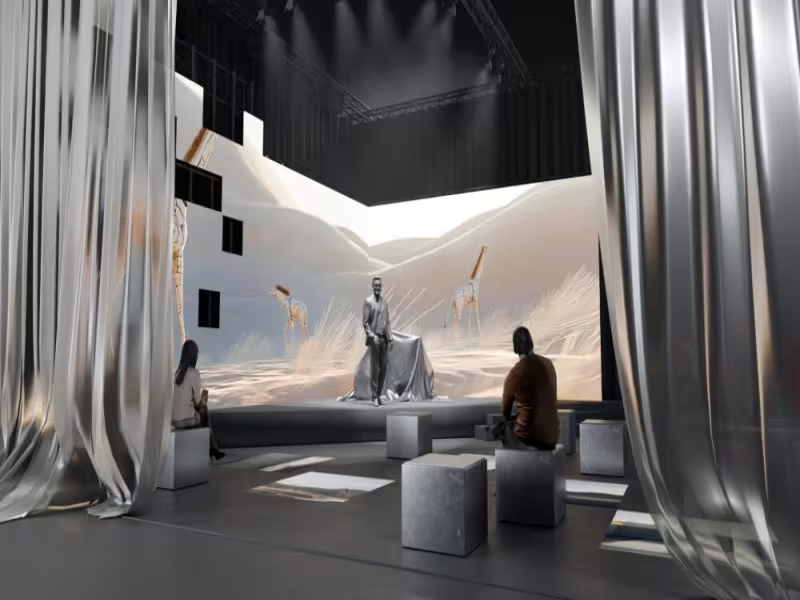
A key program element is the RETAIL(UN)COVERED stage in Hall 12. The source describes a modular stage concept developed by students from the Master's program in communication design (Studio Retail) at Hochschule Düsseldorf. The concept is intended for live events, discussions, and immersive formats, using high-resolution LED surfaces and 3D real-time worlds as the visual and spatial framework.
The curated program on this stage is structured around thematic clusters that include future, AI and technology, community and social themes, and sustainability and nature-related topics. For exhibitors and retailers, this format can function as a "fast scan" environment for how content and experience design may evolve-particularly relevant for brands that increasingly treat stores and events as media channels, not only sales points.
Community Space "Retail WG" Targets Peer Exchange and Partner Discovery
In addition to the stages, the agenda includes a community space called Retail WG in Hall 7. The stated focus is personal exchange, networking, and collaborative development across retailers, brands, and start-ups over the five show days. For operators, these formats can be particularly valuable when decisions depend on partnerships-such as integrating retail tech stacks, piloting new in-store services, or evaluating emerging solutions that are not yet standardized.
Why the Stage Program Matters for Retail Planning Cycles
A stage-driven program becomes more than "content" when it supports faster decisions on execution. The 2026 agenda, as described in the source, concentrates on areas where retail is currently balancing investment risk and competitiveness:
- AI and automation in daily retail operations and customer journeys
- Security and payments as enabling infrastructure, not back-office afterthoughts
- Store design, lighting, and materials as tools to shape dwell time and brand perception
- New business models and start-up innovation, including retail-adjacent infrastructure topics
For teams attending EuroShop 2026, the stage structure can help split responsibilities: technology and security leaders focus on system readiness, marketing leaders assess experience formats, and store planning teams evaluate physical implementation options-then consolidate findings into a realistic rollout roadmap.
Event Timing and Access
EuroShop 2026 is scheduled to run from Sunday, February 22 through Thursday, February 26, 2026, with daily opening hours stated as 10:00 to 18:00. The source also indicates that tickets are available online only.