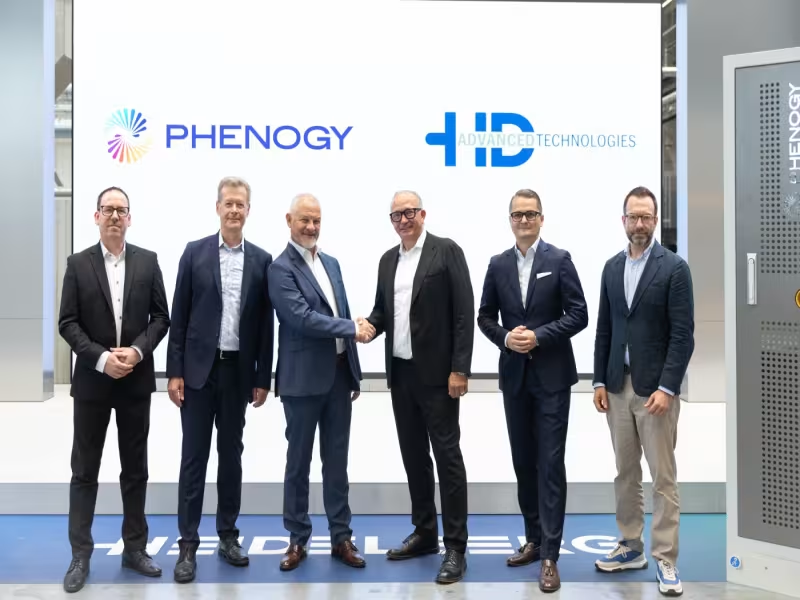
SHERIDAN, WYOMING -- July 22, 2026 -- HD Advanced Technologies GmbH (HDAT), a wholly owned subsidiary of Heidelberger Druckmaschinen AG (HEIDELBERG), has signed a two-part industrial partnership with Swiss battery developer PHENOGY AG. HDAT will take over contract manufacturing of PHENOGY's sodium-ion energy storage systems, covering everything from procurement to installation and maintenance. The two companies are also preparing a joint venture to develop and mass-produce sodium-ion battery cells, combining PHENOGY's cell chemistry with a HEIDELBERG printing process. The goal is a European-based supply chain for battery storage that does not depend on manufacturing capacity outside the region.
HDAT Takes Over Full-Scale Production of PHENOGY's Storage Systems
The manufacturing side of the deal runs on a long-term framework supply agreement. HDAT will build PHENOGY's cabinets, containers, and related system products, starting in Germany to serve European customers. U.S. production for the North American market is planned to follow.
The arrangement covers the full value chain: electronics manufacturing, assembly, rollout, installation, service, and maintenance. HDAT is drawing on local supply chains and its existing industrialization expertise rather than building new capacity from scratch.
For PHENOGY, the arrangement is about speed. Contract manufacturing lets the company put its storage systems on the market faster and at greater scale. That, in turn, frees PHENOGY's own teams to focus on cell chemistry and system design instead of production logistics.
Joint Venture Targets Cell Production From Research to Factory Floor
Beyond manufacturing, the two companies are laying groundwork for a joint venture aimed squarely at cell production. PHENOGY would contribute its sodium-ion cell chemistry and cell design. HEIDELBERG would contribute a specialized printing process, adapted from its core business, for use in cell manufacturing.
Together, the planned venture would span the full development chain — from research through industrial-scale cell production. That combination is meant to support new cell formats built to specific design and performance requirements. Preparatory work toward the joint venture is already underway.
Target applications go beyond standard commercial storage. The venture is aimed at sectors with strict performance demands: critical infrastructure, defense, and mobility.
Raw Material Independence Is the Underlying Pitch
Sodium-ion technology skips lithium and cobalt entirely, relying instead on materials that are widely available. That single fact underlies most of the partnership's stated rationale. Fewer scarce inputs means less exposure to supply chains concentrated outside Europe.
For buyers in regulated or security-sensitive sectors, that translates into a procurement argument, not just an environmental one. Supply security becomes a design feature of the technology itself.
"Europe needs battery technologies to achieve true energy sovereignty. Our partnership with HEIDELBERG finally bridges the gap between technology development and the capabilities needed to make these technologies available on an industrial scale."
Peter E. Braun, CEO of PHENOGY, framed the deal as opening new application areas as well.
"We are thus supporting the planned Europe-wide expansion of energy storage with locally manufactured battery storage systems. At the same time, the joint venture opens new potential applications for our sodium-ion technology—from KRITIS applications to autonomous systems."
HDAT Positions Itself as an Industrialization Partner, Not Just a Contractor
Michael Wellenzohn, CEO of HD Advanced Technologies, described the deal in terms of what HDAT brings to the table operationally.
"Rapidly industrializing technology and innovations opens new business areas. As a manufacturing partner, we are bringing PHENOGY's stationary energy storage systems into series production."
He tied that manufacturing role directly to the cell-production ambitions of the joint venture, describing plans to develop and manufacture cells and modules for defense, critical infrastructure, and mobility applications. That statement links HDAT's day-to-day production work to the longer-term cell manufacturing goal in one continuous strategy rather than two separate initiatives.
Deal Extends HEIDELBERG's Push Into Energy and Industrial Technology
HDAT was set up to house HEIDELBERG's activity outside its traditional printing business, with a stated focus on defense, security, and energy. The PHENOGY partnership gives that unit a concrete production mandate in the energy segment specifically.
The arrangement also puts a real customer behind HEIDELBERG's printing-process know-how in a new context: cell manufacturing rather than print production. If the joint venture proceeds as planned, it would mark a direct commercial application of that printing expertise inside the battery industry, extending HEIDELBERG's manufacturing base well beyond its original market.