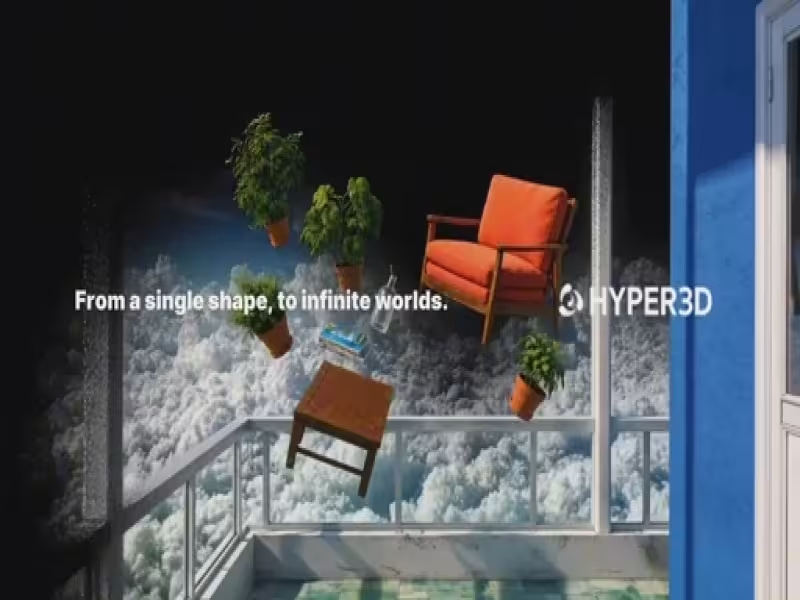
Los Angeles – September 13, 2026 -- Hyper3D has launched WorldGen, a world-generation model that converts a single image into a 3D scene made up of independent, editable objects, extending the company's generative 3D technology beyond single-object creation into full scene reconstruction for robotics, filmmaking and game development.
WorldGen builds interactive 3D scenes from one image, inferring hidden geometry and physical properties
The system automatically identifies main objects in an uploaded scene image, or lets users draw bounding boxes to select specific items for generation. It produces object geometry, including plausible shapes for hidden portions, and maps spatial relationships such as contact, support and suspension. WorldGen also estimates each object's position, scale, orientation, collision geometry, mass and friction. The model uses a hybrid representation: editable objects are generated as separate mesh assets via Hyper3D's Rodin model, while background environments use 3D Gaussian splatting for visual detail.
WorldGen advances CAST research that won a Best Paper Award at SIGGRAPH 2025
The model builds on Component-Aligned 3D Scene Reconstruction from an RGB Image (CAST), research developed by the Hyper3D team that received the award at SIGGRAPH 2025, the leading computer graphics conference. Hyper3D continued developing the underlying models and engineering systems that power WorldGen's multistage generation process.
WorldGen extends Hyper3D's NVIDIA Isaac Sim workflow from single assets to full scenes for robot training
Hyper3D, a member of NVIDIA Inception, previously added Sim-Ready capabilities for Rodin through NVIDIA Omniverse and Isaac Lab, alongside an Isaac Sim plug-in. WorldGen generates physically grounded, interactive simulation environments directly from photographs, replacing manual scene modeling for embodied AI training. In July, Hyper3D announced a joint robotics simulation workflow with D-Robotics and Motphys, in which WorldGen reconstructs scenes from photos while Motphys handles physics simulation and D-Robotics provides computing infrastructure, connecting scene generation, simulation, data collection, model training and deployment to physical robots.
Filmmakers gain a controllable 3D layer for camera and composition planning ahead of AI video generation
WorldGen lets creators set camera angles, move objects, replace assets and adjust layouts, then use rendered views as references for video-generation models such as Seedance 2.5, which adds character performance, materials and lighting on top of WorldGen's spatial structure. Hyper3D says projects using the workflow are already in production, with releases to follow.
Generated assets integrate into Blender, Unity, Unreal Engine and Tuanjie Engine, plus XR devices such as Apple Vision Pro
3D assets created in WorldGen can be exported into standard creative and game-engine pipelines for material editing, rigging and level design. In July, Hyper3D and Unity's Tuanjie Engine announced a collaboration linking 3D generation with real-time game applications, with WorldGen demonstrated at the Tuanjie Engine 2.0 launch. WorldGen-generated scenes can also be explored on XR devices, supporting interior design, immersive education and spatial content creation.