IT, AI & Telecommunications

WaitWell Grows 500% in Three Years, Ranks 57th on Canadian List

Image
WaitWell Grows 500% in Three Years, Ranks 57th on Canadian List

Canada – October 27, 2026 -- Service-operations software provider WaitWell grew 500% over three years and ranked No. 57 of 375 on Canada's Top Growing Companies list.

The platform has served nearly 45 million people and saved more than 12.8 million hours of waiting. Thousands of service locations across the United States and Canada have adopted it over the period.

Existing clients drive a significant share of WaitWell's growth

Growth came from two sources: new clients and existing clients that widened their use of the platform. The company says the second group accounted for a significant portion of the increase.

New clients include the Nevada DMV, Vancouver Coastal Health, SKIMS and UC Berkeley.

Clients typically expand in stages. A client may start with queue management, then add scheduling, more locations and more service types.


WaitWell Guide Flags Nemo-Q Tier Gaps for Public Agencies

Image
WaitWell Guide Flags Nemo-Q Tier Gaps for Public Agencies

McKinney, Texas – October 27, 2026 -- SMS alerts, appointment scheduling, multi-language service and skill-based routing all sit above Nemo-Q's $290-per-month Essentials plan, according to a WaitWell comparison of 10 queue management alternatives. WaitWell published the guide on its own site and discloses a commercial interest in its conclusions.

Entry plan caps at one location and ten workstations

Essentials includes unlimited users, visitors and service queues, plus digital signage, real-time reporting and automated workflows. Notifications are email only. A three-branch county office or a university one-stop running fifteen advising desks exceeds the plan ceiling immediately.

Agentic AI Forces Enterprises to Extend Sovereignty to Agent Actions

Image
Agentic AI Forces Enterprises to Extend Sovereignty to Agent Actions

Global – – October 27, 2026 -- Enterprises deploying autonomous AI agents must extend sovereignty controls beyond data location and model hosting to cover agent identity, permissions, execution authority and oversight. Agents can interpret goals, select tools, call APIs, update applications and delegate work to other agents within a single task.

Governance shifts from controlling access to controlling actions

Traditional AI governance centers on datasets, approved models, processing locations and user access. Agentic systems make decisions inside the workflow itself, choosing which system to query, which tool to invoke and which action follows. A procurement agent investigating a supplier issue could pull supplier records, review purchase orders, analyze delivery records, compare contract terms and initiate an approval workflow. That chain spans several databases, applications, APIs, models and identity systems.

Only 22% of Firms Apply Sovereignty Rules to AI Models

Image
Only 22% of Firms Apply Sovereignty Rules to AI Models

GLOBAL – October 27, 2026 -- Only 22% of organizations have applied sovereignty or residency requirements to AI models, against 60% for data, according to a global 2025 survey cited in a new analysis of sovereign AI architecture.

Sovereignty controls thin out higher in the AI stack

The same survey found that 46% of organizations applied such requirements to infrastructure and 32% to applications. The decline leaves a structural blind spot: protecting enterprise data has limited value if the model processing it operates outside the intended control framework.

Enterprises Weigh Sovereign LLMs as EU AI Act Deadline Nears

Image
Enterprises Weigh Sovereign LLMs as EU AI Act Deadline Nears

Europe – October 27, 2026 -- Self-hosted LLM infrastructure tends to become the cheaper option above roughly 50 million tokens processed per day, while commercial APIs usually stay more economical below 5 million, according to AppsTek's analysis of when enterprises need a sovereign LLM. The figures are illustrative and should be checked against current provider pricing and actual workload patterns.

AppsTek's third piece in its sovereign AI series argues that the model layer is now a governance decision, not only a technology choice, as generative AI moves into regulated, revenue-bearing workflows.

Agentic QE Targets Testing Unit Costs as GenAI Pilots Hit 89%

Image
Agentic QE Targets Testing Unit Costs as GenAI Pilots Hit 89%

Global – October 27, 2026 -- Some 89% of organizations surveyed for the World Quality Report 2025 are piloting or deploying GenAI-augmented Quality Engineering (QE), but only 15% have reached enterprise-wide implementation. Respondents reported an average productivity gain of 19%. Vendors such as AppsTek are pitching agentic QE as a way to hold down testing unit costs as release volumes grow.

Maintenance work pushes up the cost of enterprise test automation

Each release adds workflows, integrations and regression paths while QE budgets stay tightly controlled. The pressure shows up in maintenance, contractor spend, rework and cost per release.

AI Agent Testing Must Cover Execution Paths, Not Just Answers

Image
AI Agent Testing Must Cover Execution Paths, Not Just Answers

Global – October 27, 2026 -- Two AI agent runs can return the same correct answer while carrying very different operational risk, which makes output-only checks insufficient for enterprise Quality Engineering (QE), according to a new AI agent testing framework built around four evaluation layers.

Recovered failures can look like clean successes

In the source's example, an agent retrieving an account balance queries an unnecessary privileged system, hits an authorization error, retries twice and then reaches the approved source. The user sees a correct result. An output-level assertion marks the run as a success, while a trace-level evaluation flags it as degraded.

Foresight Targets Satellite Network Fragmentation With AI Operations

Image
Foresight Targets Satellite Network Fragmentation With AI Operations

GLOBAL – October 27, 2026 -- Foresight, a network operations platform, lets satellite operators add AI-driven management without replacing the infrastructure they have already invested in, according to a recent Via Satellite webinar.

Fragmented tools slow troubleshooting across multi-orbit networks

Multi-orbit environments, rising service expectations and expanding infrastructure have made traditional network operations harder to scale. Many operators still work across fragmented tools, disconnected data sources and siloed management systems. The result is slower troubleshooting and harder optimization.

iDirect's Foresight AI Targets Up to 60% Cut in NOC Workload

Image
iDirect's Foresight AI Targets Up to 60% Cut in NOC Workload

Global – October 27, 2026 -- ST Engineering iDirect expects its new Foresight AI platform to cut network operations center (NOC) workload by up to 60% and shrink mean time to repair from hours to minutes, according to the company's input to the World Teleport Association (WTA) report "The AI-Driven Teleport."

Foresight KPI gains are projections, not measured results

Shanthakumar Ramakrishnan, Sr. Director of Engineering, said the figures draw on industry benchmarks, operational analysis and Foresight's developing capabilities. The company has run AI proofs-of-concept in network operations, service assurance and service orchestration. It reports the most measurable value in predictive maintenance, anomaly detection and closed-loop automation.

Viettel Migrates 100M Subscribers to Cloud-Native Charging, Zero Downtime

Image
Viettel Migrates 100M Subscribers to Cloud-Native Charging, Zero Downtime

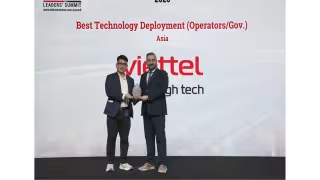
HANOI – October 27, 2026 -- Viettel High Technology Industries Corporation has migrated more than 100 million subscribers and about 5,000 tariff plans at Viettel, Vietnam's largest mobile operator, to its in-house cloud-native charging system vOCS 4.0. The three-month cutover ran on a live national network with no service disruption.

Phased cutover with instant rollback limits the risk of replacing a charging system

Replacing a charging system is one of the riskiest projects an operator can undertake, and many operators therefore stay on legacy platforms. Viettel High Tech, part of Viettel Group, reduced the risk through real-time data synchronization, parallel running and a phased cutover, with instant rollback at every stage.