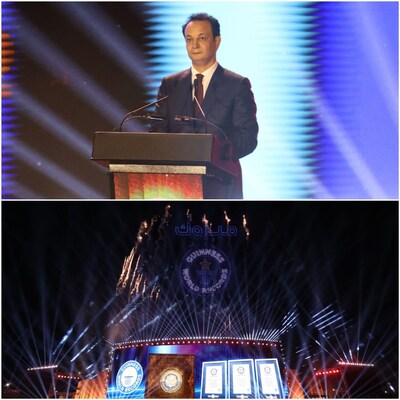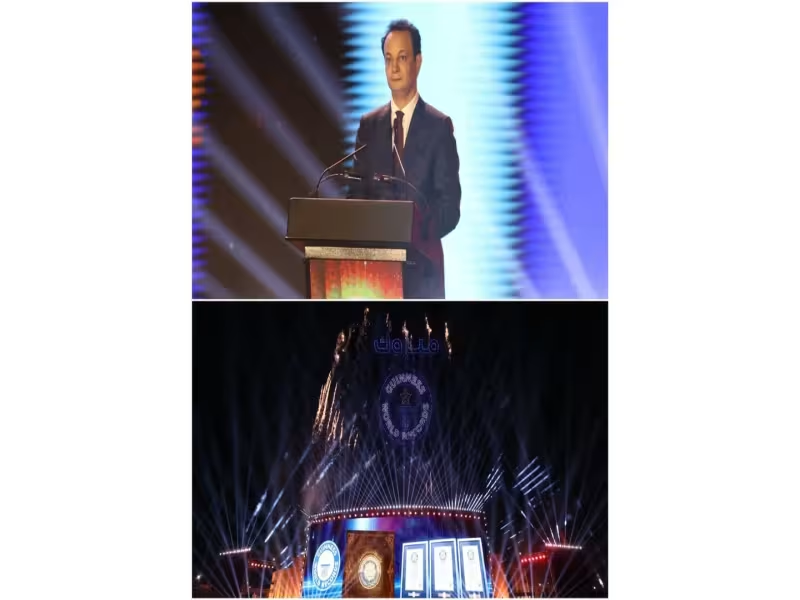
Benghazi – -- The University of Benghazi reopened all faculties and facilities on September 4, 2026, ending more than eleven years of closure caused by damage sustained during the Libyan Armed Forces' war against terrorist groups. The reconstruction was carried out by the Libyan Development and Reconstruction Fund, led by Director General Engineer Belqasim Khalifa Haftar, who personally oversaw the project.
Fund rebuilds entire university city in three years
The integrated campus reconstruction covered the Faculties of Engineering, Arts, Law, Science and Languages, plus the central library, academic and administrative buildings, laboratories, student residences, service facilities, infrastructure and internal roads. The University of Benghazi, known as the 'Mother of Libyan Universities,' serves nearly 100,000 students and has operated as a free-education institution producing generations of scientists, academics and officials.
Drone show breaks three Guinness World Records at inauguration
The ceremony, led by Field Marshal Khalifa Haftar and Engineer Belqasim Khalifa Haftar, drew prominent Libyan figures, ambassadors, international delegations and roughly 240 foreign guests. An aerial drone performance combined with 3D mapping and visual effects achieved three Guinness World Records: an eagle formation, a quill writing 'University of Benghazi' across the sky, and a peace symbol formation.
Fund pairs physical rebuild with 1,000-plus scholarships abroad
Beyond the campus reconstruction, the Fund has sent more than 1,000 university students abroad to continue their studies, linking infrastructure investment with human capital development.
Project sits within 2,300-plus development initiatives across eastern, southern Libya
The Benghazi campus reopening forms part of a broader pipeline of more than 2,300 development projects in eastern and southern Libya. These include rehabilitation of universities and educational institutions in Kufra, Al Bayda, Derna, Al Marj, Ajdabiya, Sirte, Brak al-Shati and Murzuq, alongside roughly 250 schools.