SHERIDAN, WYOMING - February 03, 2026 - Autonomous mobility in public transport has moved decisively beyond pilot concepts and is now entering a phase of operational testing, regulatory validation, and early-scale deployment. XPONENTIAL Europe 2026, taking place from March 24 to 26 in Düsseldorf, positions itself as Europe's leading platform for autonomous technologies and robotics, with a strong focus on automated, semi-autonomous, and autonomous shuttle and transport systems for public passenger transport. The event brings together technology providers, mobility operators, regulators, and cities to examine how autonomy can be integrated into real-world public transport networks and what remains to be solved before large-scale rollout.
Autonomous Mobility Shifts from Vision to Deployment
Across global markets, autonomous driving has evolved into a tangible mobility concept supported by advances in software, sensor systems, and regulatory frameworks. Autonomous buses and shuttles are already operating or being tested in multiple regions, demonstrating growing technical maturity. XPONENTIAL Europe builds on its 2025 debut, where teleoperated and autonomous shuttle systems were already showcased, and now expands the discussion to system integration, safety validation, and operational models suitable for public transport authorities.
The public transport sector is a central use case, as autonomous systems promise increased flexibility, more efficient vehicle utilization, and new on-demand mobility offerings that complement existing networks.
Public Transport as a Key Adoption Driver
In public passenger transport, autonomous systems are being evaluated as tools to address capacity constraints, labor shortages, and service gaps in both urban and suburban environments. Developments in Europe, the United States, and Asia underline the diversity of approaches currently being tested, from fixed-route autonomous buses to flexible, demand-responsive shuttle services.
However, the sector faces significant challenges. Software reliability, sensor performance, and system integration must meet strict safety requirements, while infrastructure, traffic rules, and urban planning frameworks often require adaptation. Economic viability remains a critical factor, as autonomous solutions must demonstrate sustainable operating models to become permanent components of public transport systems.
Hamburg as a Large-Scale Urban Test Environment
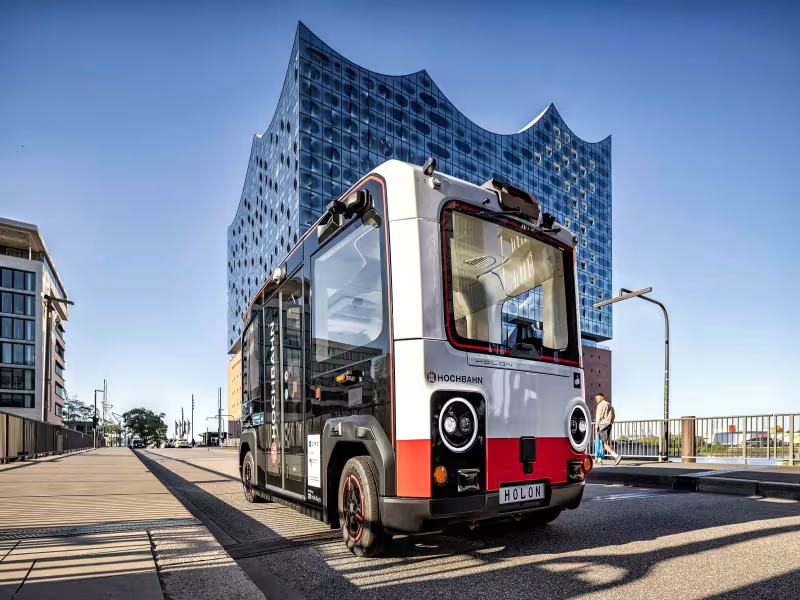
One of the most advanced European test projects is underway in Hamburg, where the ALIKE mobility initiative led by Hamburger Hochbahn is evaluating highly automated on-demand services. Two vehicle types are being tested: the already-operational ID. Buzz AD developed by MOIA and the HOLON urban autonomous shuttle, which received regulatory approval for autonomous test drives from Germany's Federal Motor Transport Authority in November 2025.
The Hamburg test area covers 37 square kilometers and serves approximately 320,000 residents, making it one of Germany's largest autonomous shuttle test zones. The HOLON urban has been designed specifically for public road use and public transport integration, with features such as full electrification, autonomous operation, barrier-free access, automated ramps, wheelchair spaces, and comprehensive audiovisual assistance systems.
Inclusion, Regulation, and System Design
Accessibility and inclusivity are increasingly recognized as prerequisites for autonomous vehicles to be accepted within public transport networks. Vehicle design must address diverse passenger needs while complying with regulatory standards. At the same time, differences between cities highlight the complexity of deployment. Concepts that work efficiently in newly planned urban environments may face higher integration hurdles in historically grown European cities with dense traffic and legacy infrastructure.
XPONENTIAL Europe addresses these realities by presenting not only vehicles but also the enabling technologies behind them, including perception systems, control software, and operational frameworks.
European Ecosystems and Global Comparisons
Autonomous mobility projects in Europe are increasingly positioned alongside international examples. Autonomous shuttle systems are already operating in numerous global cities, and further European deployments are planned. Test operations in Berlin scheduled from 2026 will examine how Level 4 autonomous vehicles can extend public transport with flexible, self-driving services, while still maintaining onboard supervision during trial phases.
The event emphasizes the role of integrated solutions that combine vehicles, software, and services into scalable systems capable of meeting public transport requirements.
XPONENTIAL Europe as a Strategic Industry Platform
By bringing together technology developers, mobility operators, policymakers, and city representatives, XPONENTIAL Europe 2026 serves as a strategic forum for assessing the readiness of autonomous public transport. The trade fair highlights how regulatory progress, technological maturity, and operational experience are converging, while also making clear where further coordination and investment are required before autonomous systems can be deployed at scale across European cities.
Learn more about XPONENTIAL Europe 2026 at https://www.xponentialeurope.com.